NW Calgary Excavation from Hillhurst to Sage Hill
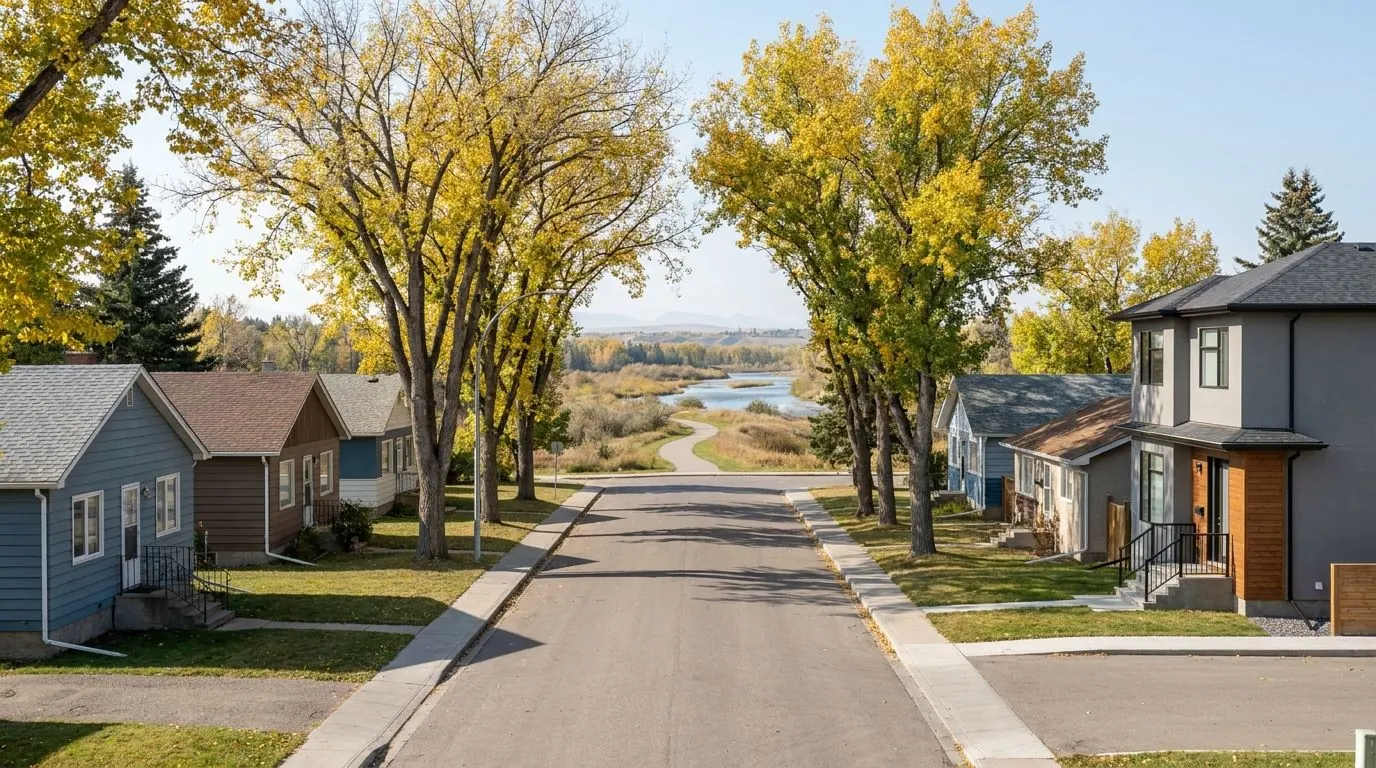
Northwest Calgary runs from inner-city streets beside the Bow River, past Nose Hill Park, to communities still being built on the city's northern and western edges. We dig infill basements in Hillhurst and Sunnyside, replace weeping tile and garage slabs in the 1950s and 1960s–70s suburbs, and excavate and backfill new-home lots out toward Sage Hill and Haskayne.
At a Glance
- Municipality
- City of Calgary
- From our downtown office
- Across the Bow River from downtown
- Typical servicing
- City water, sanitary and storm mains
- Postal prefixes
- T2N, T2M, T3A, T3B, T2L, T3G, T2K
Lots, Homes and Sites in Northwest Calgary
Five NW communities carry the City's inner-city classification: Hillhurst, West Hillhurst, Sunnyside, Rosedale and Mount Pleasant. These are redevelopment streets, where an infill starts with demolition and a basement dug close to the houses on either side. Three more need care with the quadrant. Crescent Heights and Tuxedo Park split their addresses between NE and NW, and Highland Park, a 1950s-era community, is about 77% NW. For those, the address on the land title and the permit application decides which quadrant a locate request names, so we take it from the paperwork rather than the map.
The 1950s-era belt is wide: Capitol Hill, Banff Trail, Parkdale, St. Andrews Heights, Hounsfield Heights/Briar Hill, Montgomery, Bowness, Highwood, Cambrian Heights, Rosemont, Collingwood and Charleswood. Beyond it, Varsity, Brentwood, Dalhousie, Silver Springs, Ranchlands, North Haven, North Haven Upper, University Heights, Point McKay and Greenwood/Greenbriar are largely 1960s–70s. The excavation these streets ask for is mostly on houses that stay: exterior weeping tile dug to the footing, a detached garage replaced and its slab broken out, a power feed trenched to a new garage or suite, or a knock-down on a lot that is ready for redevelopment.
Newer communities fill the north and west. Edgemont, Hawkwood, Scenic Acres, Arbour Lake, Citadel, Hamptons, Hidden Valley, Country Hills, MacEwan Glen, Sandstone Valley, Tuscany, Rocky Ridge, Royal Oak, Valley Ridge, Kincora, Panorama Hills, Evanston and Sherwood date from the 1980s through the 2010s, and Sage Hill, Nolan Hill, Carrington and Haskayne are building out or 2020s-era. Here the work is new basements, backfill against fresh foundation walls, retaining wall bases and yard drainage. Royal Vista is the only NW community the City classes as industrial, which makes pad and parking lot work a small share of the quadrant.
Neighbourhood Notes
Hillhurst & West Hillhurst
Inner-city communities along the Bow. Infill basements here start with a flood-map check for the parcel, a pumping plan and a compact machine that can work between close neighbours.
Sunnyside
An inner-city community on the river, with the largest share of regulatory flood fringe in the NW. Tight lots and close houses make spoil handling the main planning job, with trucks loaded as the basement is dug rather than stockpiled on site.
Rosedale & Mount Pleasant
Inner-city communities classed by the City for redevelopment and infill. The usual order is demolition, footing removal, old services disconnected at the main, then the new basement.
Bowness & Montgomery
1950s-era communities by the City's structure data, both along the Bow. Basement and drainage work gets the same parcel-by-parcel flood check as the inner-city river streets.
Capitol Hill, Banff Trail & Parkdale
1950s-era communities where a house may be original or already replaced. Typical work is garage replacement, weeping tile, power trenches to garages and full knock-downs.
Varsity, Brentwood & Dalhousie
Largely 1960s–70s suburbs. Exterior foundation drainage, basement floor breakout and settled backfill against the foundation are the jobs we plan around in homes of this generation.
Tuscany, Rocky Ridge & Royal Oak
Newer communities at the western edge of the city, toward Bearspaw. Retaining wall bases, backyard regrading and drainage corrections are typical, always worked back to the lot's approved grades.
Sage Hill, Nolan Hill, Carrington & Haskayne
Communities still building out. Open lots take full-size machines for new-home basements, then backfill in lifts and a finished grade that has to pass the lot grading certificate.
Permits and Locates in Northwest Calgary
Authority having jurisdiction: City of Calgary
The City of Calgary issues building and development permits across the NW. Two thresholds come up often. A retaining wall needs a building permit when it retains 1.2 m (4 ft) or more of soil, and that includes the combined height of walls and garden boxes within 1 m of each other; structural plans are stamped by an Alberta professional engineer, and the Safety Codes Officer can ask for a permit even on a lower wall. The City's pages differ on whether a development permit is triggered at 1 m or 1.2 m, so confirm with the City. New homes fall under the Lot Grading Bylaw: at least a 4% slope within 1.2 m of the foundation, 2% on grassed areas, no slope steeper than 33%, and an as-constructed grade certificate signed by a land surveyor, engineer or architect. A locate does not last forever: marks hold for at most 30 calendar days, or less if the report sets an earlier expiry, so a delayed start can mean refreshing them.
The Excavation Work Northwest Calgary Calls For Most
Infill Lot Digging & Tight-Access Excavation
Mini and midi excavator digs on narrow infill lots beside neighbouring homes.
French Drain & Weeping Tile Excavation
Digs to the footing, new perforated tile in clear stone, and yard French drains.
Residential Building & Garage Demolition
House and garage teardown, foundation removal and a level lot for the next build.
Shallow Utility Trenching
Narrow trenches for gas, electrical conduit, fibre and suite power feeds.
Retaining Wall Base Excavation
Wall base trenches, compacted levelling pads and drainage. We dig; your builder builds.
Deep Basement Excavation
Full and walkout basement digs for new custom homes on open lots and acreages.
Close to Northwest Calgary
The core, Beltline, Eau Claire and Downtown East Village: tight sites under City streets.
Inner-city infills in Altadore and South Calgary out to the newer west-side communities.
Country residential acreages northwest of Calgary, between Highway 1A and Cochrane.
Bridgeland and Renfrew infills, warehouse districts and the northeast suburbs.
Excavation in Northwest Calgary: Questions
Can you dig a basement in NW Calgary in the middle of winter?
Should I replace the weeping tile on a 1960s-era house in Varsity or Brentwood?
Do you work past the western edge of NW Calgary, in Bearspaw?
Digging in Northwest Calgary?
Call or send the details. Aspen Excavating works from downtown Calgary, and we will look at the site and the access before we price it.