SW Calgary Excavation for Infill, Suburban & River Lots
Southwest Calgary holds the city's biggest belt of inner-city infill lots, the Elbow River communities where groundwater did much of the 2013 basement damage, long rows of 1950s and 1960s–70s suburbs, and communities still building out on the west edge. We demolish, dig, prepare for underpinning, drain and backfill across all of it, and the ground, the water and the house next door decide how each job is done.
At a Glance
- Municipality
- City of Calgary
- From our downtown office
- Minutes south and west of downtown
- Typical servicing
- City water, sanitary and storm mains
- Postal prefixes
- T2T, T3E, T2V, T2W, T3H, T2Y
Lots, Homes and Sites in Southwest Calgary
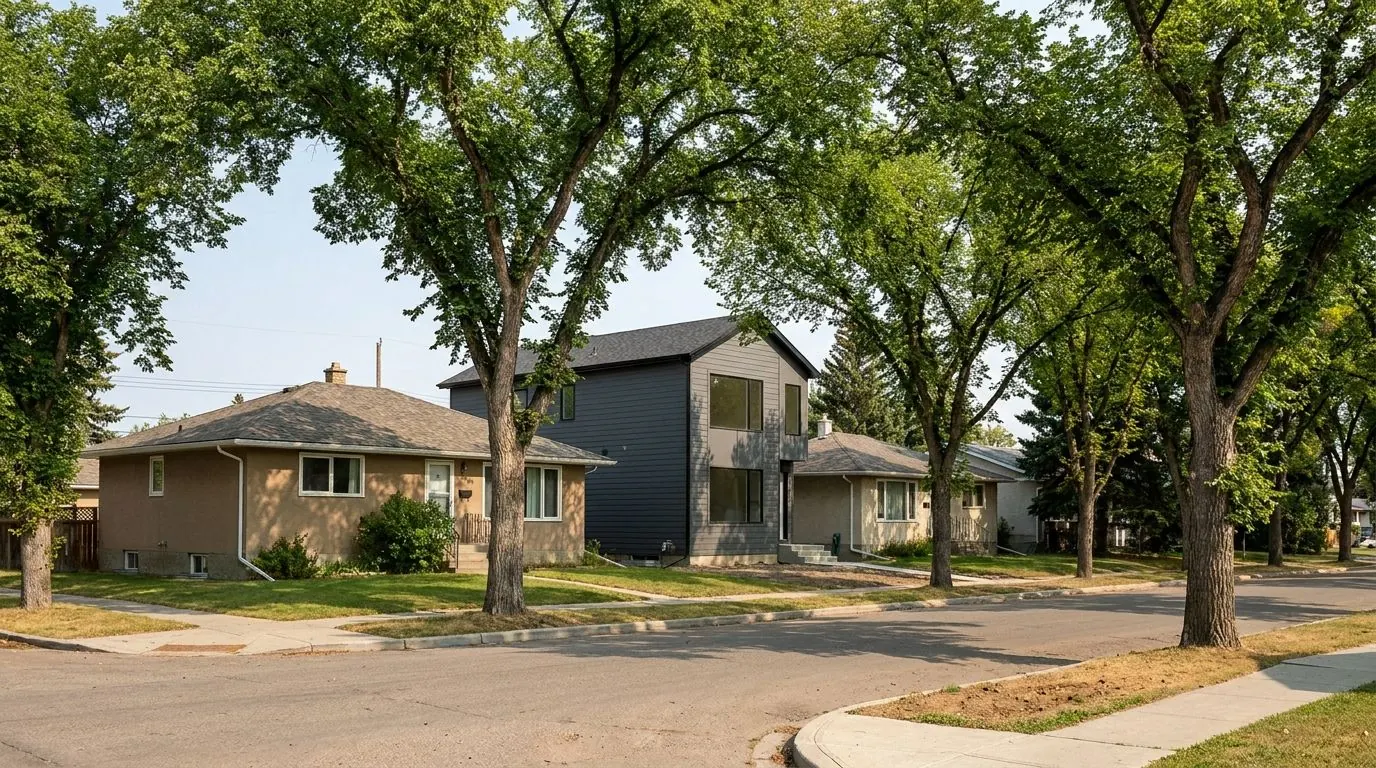
By the City's classification, 14 inner-city communities address mainly to SW, far more than any other quadrant. In Altadore, South Calgary, Bankview, Sunalta, Scarboro, Upper and Lower Mount Royal, Cliff Bungalow and Garrison Woods, new homes replace old ones one narrow lot at a time. The neighbouring houses are close, so the dig is planned around them: a compact excavator loading trucks from the lot or the lane, spoil kept at least 1 m back from the edge of the hole, and a neighbour's foundation supported to an engineer's design before we dig beside it, where one is needed.
The mid-century suburbs are a different kind of work. Killarney/Glengarry, Richmond, Glenbrook, Glendale, Rosscarrock, Wildwood, Spruce Cliff, Haysboro, Kingsland, Chinook Park, Mayfair, Elboya, Britannia, Windsor Park and Meadowlark Park carry the City's 1950s structure class. Lakeview, Bayview, Pump Hill, Southwood, Palliser, Canyon Meadows, Oakridge, Braeside, Cedarbrae, Kelvin Grove and Eagle Ridge are largely 1960s–70s. On these streets the house on a lot may be the original or its replacement, and the job follows from that: weeping tile dug out to the footing, a basement floor broken out for lowering, a garage slab removed, or a full knock-down and rebuild.
Further out, Signal Hill, Patterson, Coach Hill, Christie Park, Strathcona Park, Woodbine, Woodlands, Millrise, Somerset, Evergreen, Bridlewood, Discovery Ridge, Cougar Ridge, Crestmont and Medicine Hill are 1980s–2000s communities, and West Springs, Aspen Woods, Springbank Hill, Currie Barracks, Garrison Green, Silverado, Yorkville, Belmont, Pine Creek and Alpine Park are still building out. There the work is new-home basements on open lots, foundation backfill, yard drainage and retaining wall bases. The SW has very little industrial land: Manchester addresses to SW, and Manchester Industrial sits along the SW–SE line.
Neighbourhood Notes
Altadore & South Calgary
Inner-city communities the City plans for redevelopment and infill. A project here usually means demolition, a full basement dig beside close neighbours and trucks loaded from the street or lane.
Bankview, Sunalta & Scarboro
Established inner-city streets close to the core. On narrow lots with little room to stage, machine size and truck positions get settled before the demolition permit is even issued.
Mount Royal & Cliff Bungalow
Inner-city infill streets near the Elbow. Cliff Bungalow is the one to check against the flood maps: about 11% of it lies in the regulatory flood fringe and about a quarter in the overland flow zone, so a basement dig there starts with the parcel's mapping.
Elbow Park, Rideau Park & Roxboro
The three communities in the University of Calgary groundwater study. Basement lowering, underpinning prep and weeping tile work here gets an engineer's input on depth and water before we open the ground.
Mission
Among the first communities flooded and evacuated in 2013. About 95% of addresses are SW and the rest SE, and about a fifth of the community lies in the regulatory flood fringe. Dewatering and sump discharge routing are part of the plan for any excavation below the floor.
Killarney/Glengarry, Glendale & Rosscarrock
1950s-era communities by the City's classification. When an original house comes down, the job is demolition, removal of the old footings and a new basement dug to the builder's elevations.
Lakeview, Oakridge & Palliser
Largely 1960s–70s suburbs. Typical work is on homes that stay standing: exterior weeping tile replacement, basement floor breakout, garage slabs and backfill that has settled against the foundation.
West Springs, Springbank Hill & Currie Barracks
Communities the City lists as still building out. Open lots mean full-size machines, new-home basements, backfill and retaining wall bases, with the lot graded for its final certificate.
Permits and Locates in Southwest Calgary
Authority having jurisdiction: City of Calgary
Most SW infill projects start with a City of Calgary demolition permit, needed to remove a building from a site or reduce it to its foundation. Before demolition, the building must be inspected by a professional asbestos removal company, and the applicant must confirm there is no asbestos or have it professionally removed; the City's Asbestos Abatement Information Form is submitted before the permit is released. Utilities must be disconnected under a signed Service Disconnection Request, with the water service disconnected at the main by an indemnified contractor, and new connections, public and private portions, are at the lot owner's expense. The City also asks for a Tree Protection Plan when work comes within 6 m of a public tree; every demolition permit also gets a heritage review. On locates, the utility does not mark private lines such as power run from the house to a garage; those need a private locator.
The Excavation Work Southwest Calgary Calls For Most
Residential Building & Garage Demolition
House and garage teardown, foundation removal and a level lot for the next build.
Infill Lot Digging & Tight-Access Excavation
Mini and midi excavator digs on narrow infill lots beside neighbouring homes.
Underpinning & Basement Lowering Prep
Excavation and spoil removal for engineered underpinning and basement lowering.
French Drain & Weeping Tile Excavation
Digs to the footing, new perforated tile in clear stone, and yard French drains.
Deep Basement Excavation
Full and walkout basement digs for new custom homes on open lots and acreages.
Foundation Backfilling & Perimeter Grading
Compacted backfill against new foundations and a perimeter grade that sheds water.
Close to Southwest Calgary
The core, Beltline, Eau Claire and Downtown East Village: tight sites under City streets.
Bow River infills in Hillhurst and Sunnyside, Mount Pleasant, and the northwest suburbs.
Two-acre country residential lots between the Bow and Elbow rivers, west of Calgary.
Inglewood and Ramsay infills, the largest industrial belt and newer deep-south suburbs.
Excavation in Southwest Calgary: Questions
Can you lower a basement in Elbow Park or Roxboro?
How do you dig a full basement beside a neighbour's house on a narrow SW lot?
Do you work on the new lots in West Springs and Springbank Hill?
Digging in Southwest Calgary?
Call or send the details. Aspen Excavating works from downtown Calgary, and we will look at the site and the access before we price it.