Hydrovac Excavation & Daylighting in Calgary
Hydrovac excavation uses pressurized water to loosen soil and a powerful vacuum to lift it away, so buried gas, power, water and telecom lines can be uncovered without a steel bucket touching them. We daylight lines, cut slot trenches and dig test holes across Calgary, and take the slurry to an approved facility.
The Problem It Solves
A locate tells you roughly where a line runs, not how deep it is or exactly where inside the paint it sits. Alberta treats the strip 1 m on each side of the marks as the hand-expose zone, 5 m each side for a high-pressure pipeline, and no mechanical excavation is allowed there until the line has been exposed. That rule is simple on paper and hard in practice. Hand-digging clay down to a water service that may sit 2.7 m deep, or to a gas main under a road, is slow, exhausting work, and shovels and bars still dent coatings and cut cables.
The alternative people are tempted by, easing a bucket down “carefully” beside the paint, is how lines get hit. A torn gas service means an evacuation and an emergency repair. A cut fibre bundle can take out service for a whole block and bring a repair invoice with it. A strike on a pipeline brings the operator, the regulator and a work stoppage, and damage a crew never noticed, such as a scraped coating or a cracked plastic fitting, can fail months later. Every one of those outcomes costs more than exposing the line properly would have.
Winter makes it worse. Utility Safety Partners is explicit that frozen ground does not mean underground facilities no longer have to be hand exposed; the options it gives are thawing the ground or using non-destructive excavation. Picks and bars in frozen clay are neither fast nor gentle on what is buried, and waiting for spring stalls a project that has trades and inspections booked. Without a non-destructive way to get down to the line, crews either lose weeks or cut corners they should not cut.
How It Works
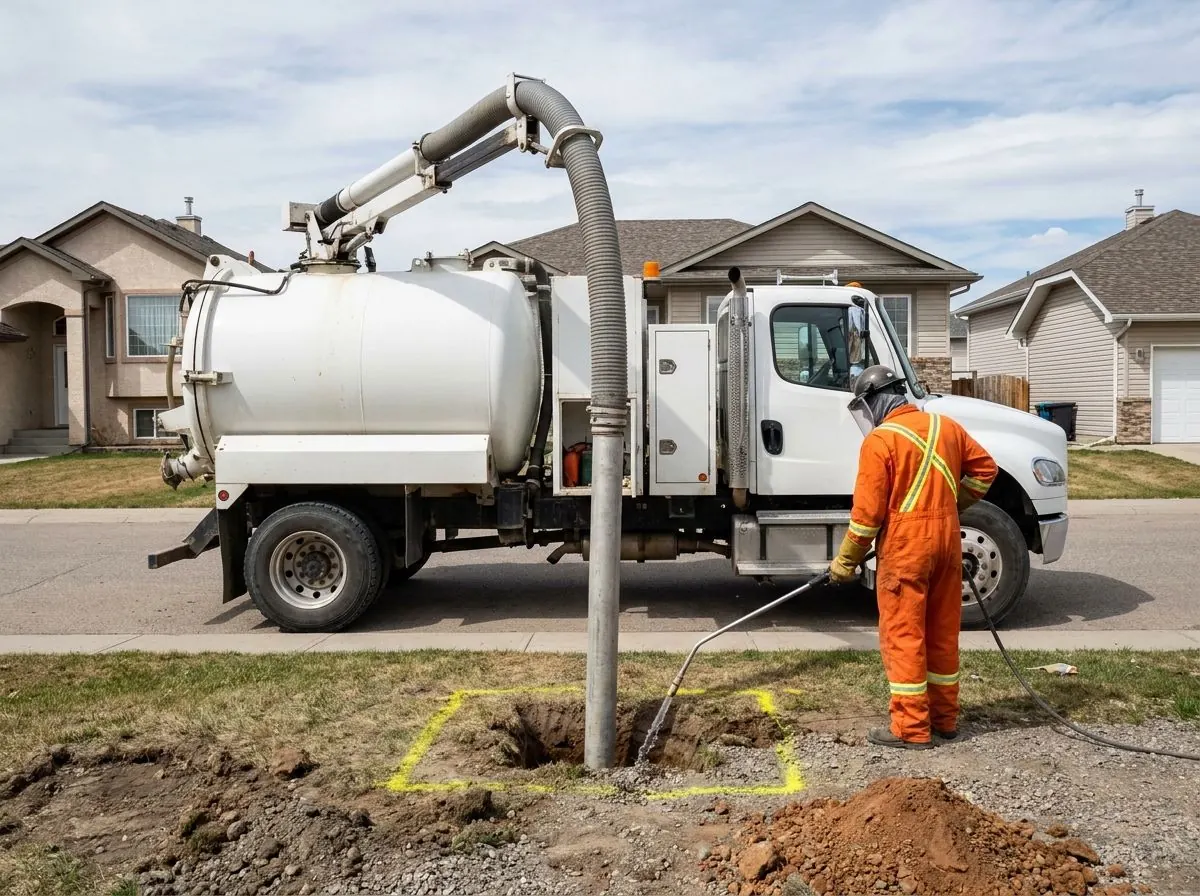
A hydrovac truck works in two halves at once. An operator directs a stream of pressurized water through a handheld wand to cut and loosen the soil, and a large-diameter suction hose immediately lifts the loosened material into a debris tank on the truck. There are no teeth, no bucket and no steel edge in contact with the line. Kept moving and held at a sensible distance, the water opens a clean, tight hole down to the facility, which can then be seen, measured, photographed and protected. It is a non-destructive technique that Alberta’s OHS Code allows for hand exposure where it is acceptable to the facility owner.
The same tool does several jobs. Daylighting, or potholing, exposes a line at the point where a new trench, pile, post or footing will cross or come close to it. Slot trenching cuts a narrow trench across a proposed route so every buried crossing is found before a machine digs the length of it. Test holes confirm what is underground at a pile or sign location, or give a look at the soil profile. Because the hole is only as wide as the nozzle work, hard surfaces and landscaping around it are disturbed far less than by an open excavation.
Cold weather is where hydrovac pays its way. Heated water is a common trade practice for cutting frozen ground, so exposure can continue through a Calgary winter instead of waiting for thaw, though deep frost still slows it down. And the material that comes out is dealt with properly: Alberta classifies hydrovac slurry as waste, no longer soil and no longer water, and it goes to an approved waste management facility. It is not spread on the site, tipped in a ditch or passed off as clean fill.
How the Job Runs, Step by Step
Review the locate sheets and the dig plan
We start from the locate report and the marks on the ground, not from memory. The dig plan shows every place the work will enter a hand-expose zone, and whether any pipeline lies within 30 m, which brings its own notice period and exposure rules. Private lines the utility did not mark are identified with the owner. If a locate’s validity window is close to running out, the refresh is requested before the truck arrives.
Set up the truck and protect the site
The truck is positioned so the boom and suction hose reach every hole without dragging across finished surfaces, and ground protection goes down where the hose and crew will work. Traffic control, barricades and pedestrian protection are set on streets and sidewalks. Water pressure and temperature are set to suit the soil, the season and the facility being exposed, and plastic or composite pipelines are dug to the manufacturer’s recommendations.
Excavate over the mark in controlled passes
The operator works the wand in steady passes across the marked area, lowering the hole in stages rather than drilling straight down in one spot, until the facility appears. Its location, depth, size and material are measured and recorded, and photographed where the client needs a record. If a line cannot be found, digging continues to 600 mm below the planned excavation depth, and then the owner is contacted before anything else happens.
Support, protect and hand off
Exposed utilities are supported so they cannot sag, and protected from the next phase of work. Once a line is visible, the main excavation crew knows exactly where it can dig with a machine and where it cannot. If the facility is a pipeline, the operator is notified before any backfilling over it, as Alberta’s OHS Code requires. Open holes are covered or barricaded whenever the crew is not standing at them.
Backfill the holes and dispose of the slurry
When the exposed lines are no longer needed open, holes are backfilled with suitable material placed and compacted in lifts, not with the slurry that came out of them. The debris tank is emptied at an approved hydrovac waste facility from the list the Province publishes, and the disposal is documented so the waste generator can show where it went.
Equipment on This Job
Hydrovac truck
Carries the water tank, the high-pressure pump, the vacuum system and the sealed debris tank on one chassis, with a boom that reaches the hole from the street or driveway. The vacuum lifts loosened soil the moment it is cut, so the hole stays clean and the facility stays visible.
Heated water system
Warms the digging water so it can cut frozen ground in a Calgary winter. It is common trade practice rather than a regulatory requirement, and deep frost still slows progress, but it keeps exposure work moving when a shovel would barely mark the surface.
Handheld wand and nozzle
The operator’s tool for directing water at the soil, not at the line. Pressure and distance are controlled by hand, and the wand is kept moving so the stream loosens soil without cutting coatings, cable jackets or plastic pipe.
Suction tube and ground protection
The rigid digging tube on the end of the vacuum hose lifts slurry out of narrow, deep holes. Mats and boards under the hose and around each hole protect lawns, pavers and concrete from the weight of the hose and the traffic of the crew.
What Decides the Specification
Soil controls pace. Heavy clay typically cuts slowly and holds a neat, vertical hole; sand and gravel usually cut fast but can slough in from the sides, making the hole wider than planned; frozen ground has to be cut with heated water and patience. Depth multiplies all of it, because a hole down to a deep water service is a very different volume of slurry from a shallow pothole over a telecom line. The number of holes and how far apart they sit decides how much time goes into moving and resetting the truck.
Water and disposal set the practical limits. The truck’s water supply and debris tank capacity decide how many holes can be dug before it has to refill or empty, and the distance to an approved hydrovac waste facility decides how long each round trip takes. Pipe material matters too: on polymeric or composite pipelines, the pressure and technique follow the manufacturer’s recommendations and must be acceptable to the pipeline licensee, which can mean lower pressure and slower progress close to the pipe.
Code, Safety and Permit Notes
Hydrovac is a digging method, not a way around the locate. Utility Safety Partners lists hydrovacing as a ground disturbance, so locates are requested first and the work waits until every line is marked or cleared. Alberta’s OHS Code defines the hand-expose zone as 1 m wide on each side of the locate marks, or 5 m for a high-pressure pipeline operating at 700 kPa or more, and requires exposure there by hand digging or a non-destructive technique acceptable to the owner. It also bars mechanical equipment within 600 mm of a buried pipeline unless a representative of the owner is directly supervising.
For pipelines, Alberta’s Pipeline Rules add a 30 m controlled area either side of the centreline, notice to Utility Safety Partners at least 3 and not more than 10 days ahead for work there, excluding weekends and holidays, and hand exposure once a ground disturbance comes within 5 m. On waste, the Province’s hydrovac waste guidance says the generator is responsible for classifying and characterizing the waste under the Waste Control Regulation, and that it must go to an approved waste management facility; Alberta publishes a list of facilities that accept hydrovac waste, including several in the Calgary area.
General guidance only. The municipality, Alberta’s safety codes and the engineer of record, where there is one, decide what applies to your job.
Around Calgary
In the Downtown Commercial Core and the Beltline, buildings run lot line to lot line with no side yards, and the gas, power, water, sewer and telecom lines serving them are packed under the street and sidewalk. A conventional excavation there means opening a lot of pavement near a lot of live utilities. Hydrovac daylighting lets a crew confirm each crossing through a small hole, keep the sidewalk mostly intact, and work beside traffic with a much smaller footprint, which makes it a sensible first step for utility work in the downtown core, where digging into a City road right-of-way also needs an Excavation Permit.
In the NE industrial districts around the airport, such as McCall and Sunridge, a new pad, pile foundation, sign or utility extension may be going onto a lot that existing services already cross. On work like that, slot trenches across a proposed utility route and test holes at pile locations find the buried lines before the heavier equipment arrives. The same approach suits residential work anywhere in the city where a deep water service at 2.7 m or more has to be found before a new trench crosses it.
Often Done Alongside
Deep Utility Trenching (Water, Sewer & Storm)
Shored, bedded trenches for water, sanitary and storm service lines.
Shallow Utility Trenching
Narrow trenches for gas, electrical conduit, fibre and suite power feeds.
Emergency Utility Leak Dig-Outs
Priority dig-outs that expose broken water and sewer lines for the repair crew.
Where We Do This Work
Calgary, quadrant by quadrant
Acreage country
Neighbouring cities and towns
Hydrovac Daylighting: Questions We Get
If hydrovac is non-destructive, do I still need Click Before You Dig?
Can hydrovac excavation work through a Calgary winter?
Where does the hydrovac slurry go?
Is hydrovac always better than hand digging near a buried line?
Who handles utility locates and permits?
Get a Written Estimate for Hydrovac Daylighting
Send the basics and we will come back with questions or a time to look at the site. Drawings, a geotechnical report or photos of the access all help.
Considering Hydrovac Daylighting?
Call Aspen Excavating or send the details. We will look at the site, tell you whether hydrovac daylighting is the right scope, and price it in writing.