Skip to content

Broken water service, collapsed sewer line or undermined footing? Call for priority dispatch.

(825) 475-5548
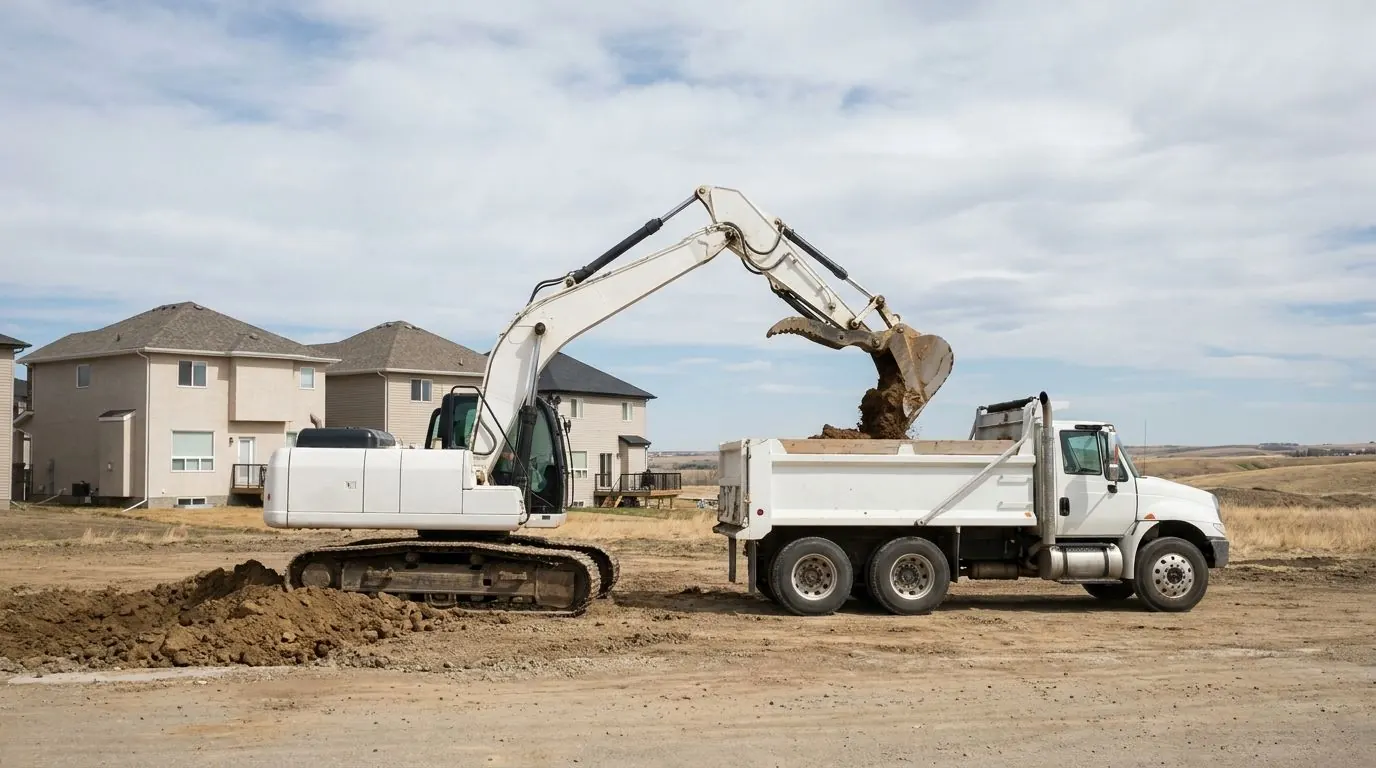
A large tracked excavator loads brown clay soil into a dump truck on a new home lot, with new two-storey houses and a wide prairie sky behind.

Excavation · Earthworks · Demolition · Drainage · Calgary, AB

Excavation Contractors for Calgary Homes, Acreages & Sites

Basements and infill digs, lot grading and compaction, water, sewer and storm trenches, hydrovac daylighting, house and garage demolition, concrete breakout, drainage, retaining wall bases, culverts, ponds and emergency dig-outs. Located before we dig, checked to grade as we go, and backfilled so it stays put, across Calgary, Rocky View County, Springbank, Bearspaw, Airdrie, Cochrane, Chestermere, Okotoks, De Winton and Heritage Pointe.

Excavation and Earthworks Services, by the Job

Six groups of work, from a single sewer service trench to a commercial pad. Each service page explains the method, the equipment, the depths and materials, the permits and locates involved, and when you would be better off choosing something else.

Start With the Job You Have

Most people do not phone asking for a machine. They phone because a basement has to be dug, a line has broken, an old garage has to go or the basement floods every spring. These are common reasons people around Calgary call an excavator.

A new infill basement between two existing houses

Narrow lot, neighbours’ foundations a few metres away, a laneway for access and nowhere to stockpile. The machine class, the shoring plan and the trucking all follow from that.

Infill Lot Digging & Tight-Access Excavation

A water or sewer service that has to be replaced

An old service line from the street to the house, laid with the cover the City’s standards call for, bedded properly and backfilled so the lawn and sidewalk do not sink.

Deep Utility Trenching (Water, Sewer & Storm)

An old house or garage coming down

Hazardous materials checked first, services disconnected, the structure and its foundation taken out, debris sorted, and the lot left level and ready for the next build.

Residential Building & Garage Demolition

Water in the basement every spring melt

Digging down the outside of the foundation to replace failed weeping tile, bed it in clean gravel and route the water to a sump or the storm system, never the sanitary sewer, then regrade so the surface water goes away.

French Drain & Weeping Tile Excavation

A new septic field for an acreage home

Tank pit, field trenches or mound base dug to the designer’s plan and the provincial standard, with the access and the well setbacks thought through before the machine arrives.

Septic System & Field Excavation

A broken line that cannot wait

Water surfacing in the yard, a sewer backing up from a collapsed line, or a washout under a footing. Priority dispatch, a located and safe dig, and the break exposed for repair.

Emergency Utility Leak Dig-Outs
Four Steps

How an Excavation Job Runs With Us

The locate, the depth and the compaction matter as much as the digging. Here is what happens between the first call and the day the last truck leaves, and what you get to see at each point.

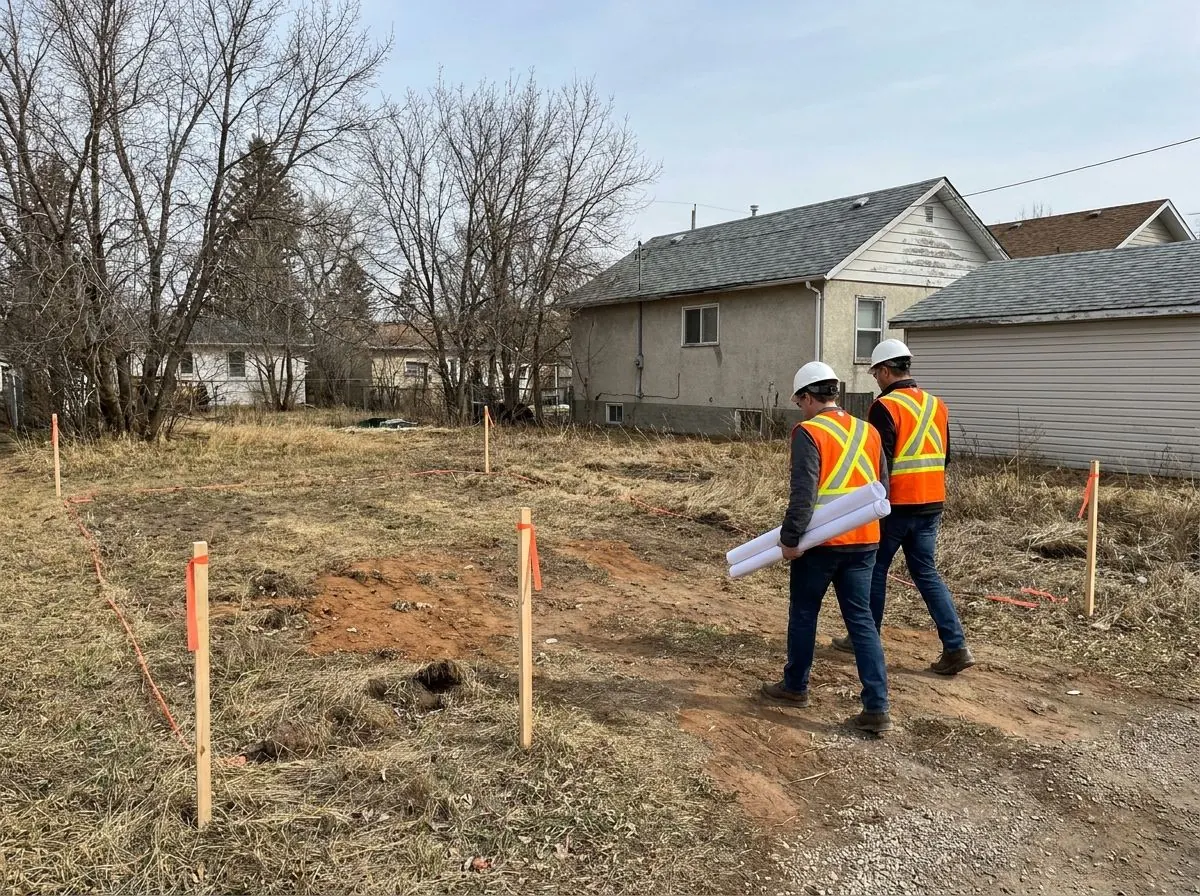
Two people in hard hats and high-visibility vests, seen from behind, walk a vacant lot with rolled drawings under an arm, past wooden stakes with orange flagging.
1

Site Visit, Drawings and Access

We walk the site with the drawings, the geotechnical report if there is one, and the permit conditions. We look at the access route, overhead lines, trees, neighbours’ foundations and where trucks can load. The written quote names the machine class, the depths, the backfill material and the haul-off.

Utility safety

Every Dig Starts With a Locate

Before any ground is disturbed, buried utilities are located and marked. In Alberta, locate requests go through Utility Safety Partners, the province’s one-call service, using Click Before You Dig. We request locates for the dig area and keep the paperwork on site.

How hydrovac daylighting exposes lines safely
  • Requested ahead of the dig

    Utility Safety Partners asks for at least three full working days’ notice, and busy seasons can take longer, so locates are requested well before the machine is booked, not on the morning of the job.

  • Exposed before a bucket goes near

    Within 1 metre either side of a locate mark, or 5 metres for a high-pressure pipeline, the line is exposed by hand or by a non-destructive method the line owner accepts, such as hydrovac, before any machine digs there.

  • Private lines are not marked

    Utility locates stop at the utility’s own equipment. Power to a garage or shop, a gas line to a barbecue or heater, yard lights, irrigation, well lines and septic pipes belong to the owner, so tell us where they run.

Machines Matched to the Site

A zero-tail-swing mini excavator for the backyard reached through a gate, a full-size machine for the acreage basement, a dozer with laser or GNSS grade control for the pad. The access decides the class before the size of the hole does.

All equipment classes

Mini & Compact Zero-Tail-Swing Excavators

Roughly 1 to 6 tonnes

Small tracked excavators, the zero-tail-swing ones with an upper house that turns inside the width of the tracks, so the counterweight never swings past the machine into a fence, a neighbouring wall or a laneway.

Where we use it

Midi Reduced-Tail-Swing Excavators

Roughly 6 to 10 tonnes

The middle class, with weight classes that vary by manufacturer: enough reach and breakout force to dig a full basement or a deep service trench, with a short tail that keeps the machine working on a narrow city lot.

Where we use it

Full-Size Excavators

Above roughly 10 tonnes

Large tracked excavators with the reach, bucket size and stability to move volume quickly and dig deep, open excavations safely back from the edge.

Where we use it

Compact Track Loaders & Skid Steers

Compact class

Nimble loaders on rubber tracks or wheels that carry buckets, grapples, augers and grading attachments, and move material around a site without rutting it the way wheels on wet clay do.

Where we use it

Dozers With Laser or GNSS Grade Control

Small to mid-size crawler dozers

Crawler dozers push and spread material across large areas. Paired with a rotating laser or satellite-positioning machine control, the blade holds a designed elevation and slope instead of relying on eye and stakes alone.

Where we use it

Hydraulic Breakers & Attachments

Matched to the carrier machine

Hydraulic hammers, ripper teeth, grapples, thumbs, tilting ditch buckets and compaction wheels that turn one excavator into several tools.

Where we use it

Why Digging Around Calgary Takes Planning

The same hole dug somewhere mild would be a simpler job. Here, three things shape nearly every excavation: how deep the frost goes, what the soil is made of, and how much water arrives at once.

Deep frost and long winters

Frost around Calgary typically reaches around 2 m (about 7 ft), and in the extreme winter of 2019 the City reported it at 2.4 m (8 ft). That is why City water services need 2.7 m of cover in clay, why footings are set to the code’s minimum depths, and why frozen material never goes back into a trench as backfill.

Water, sewer and storm trenching

Clay, till and cobbles

Ground changes from one lot to the next: clay that holds water and needs kneading to compact, sand and gravel that drain but slough, and river-valley communities where groundwater, not just surface water, flooded basements in 2013. The soil decides how steep an excavation wall can stand, what can go back in as backfill, and how a subgrade is compacted, which is why a geotechnical report is worth having on bigger jobs.

Subgrade compaction and proof rolling

Spring melt and summer storms

Snowmelt arriving on still-frozen ground and short, heavy summer storms send a lot of surface water toward foundations, driveways and ditches at once. Lot grading that falls away from the house, working weeping tile, properly sized culverts and stable slopes are what keep that water from becoming a wet basement or a washout.

Foundation backfill and perimeter grading

Where We Work

Every Calgary quadrant from our downtown office, the acreage country to the west and south, and the cities and towns around them. Each area page covers the lots, the ground, the servicing and whose permits apply.

Tell Us About the Dig

A few details are enough to start: the type of work, where the site is, the access and your timeline. Drawings and a geotechnical report help if you have them. We come back with questions or a time to look at the site, then a written quote that names the depths, the machine class, the backfill and the haul-off.

  • Written scope and price before any work
  • Locates arranged before digging
  • Permits and inspections sequenced with the builder or owner
What drives excavation cost

Request an Excavation Estimate

Tell us what needs digging, where, and when. We reply with questions or a site visit time, then a written quote.

Where are you with drawings and permits?
Or call (825) 475-5548

Sending opens your email app with these details filled in, addressed to us. Nothing is sent until you press send there.

Questions Before You Book an Excavator

How do you scope and quote an excavation job?
From the site or the drawings, not a guess over the phone. We look at access for machines and trucks, overhead lines, what is likely buried, the soil and any sign of groundwater, and how deep the dig goes, because work in excavations deeper than 1.5 m brings sloping or shoring under Alberta’s OHS Code. We work out how much material comes out, whether it is stockpiled or hauled away, and what backfill or gravel comes in. The written quote says what we dig and haul, which locates and permits apply, what engineers or other trades do, and the assumptions, such as soil conditions, that could change it.
Can excavation be done in a Calgary winter?
Much of it can, with more planning. Frost around Calgary is typically about 2 m deep and reached 2.4 m (8 ft) in the extreme winter of 2019, so the frozen crust may need breaking or thawing first. Frozen ground does not remove the duty to hand-expose located lines; that means thawing or a non-destructive method such as hydrovac. Frozen material is never used as backfill, and City of Calgary specifications do not permit it in utility trench backfill, foundation excavation bottoms have to be kept from freezing, and natural frost never counts as shoring. A mid-winter thaw can also bring meltwater and mud into an open hole, so we plan for pumping and cleanup.
Who handles utility locates and permits?
Locates are requested through Utility Safety Partners, Alberta’s Click Before You Dig service, before any ground is disturbed, and contractors must place requests online. Allow at least 3 full working days’ notice, and plan for longer in busy season. Marking utility-owned lines carries no charge, and locates are valid for up to 30 calendar days, or as stated on the locate report. Private lines, such as power from a house to a garage or water and sewer past the property-line shut-off, are not located by the utility and need a private locator. Permits are issued by the municipality, whether the City of Calgary, a county or a town, and we confirm what the job needs before digging.
How do I know the backfill and grading were done right?
Most of it can be checked. Backfill should go in lifts, each compacted before the next, never pushed in all at once; on City of Calgary road work, for example, soil lifts are capped at 200 mm. Within 600 mm of a foundation, the building code bars debris and boulders larger than 250 mm. Finished grade in Calgary needs at least a 4% slope within 1.2 m of the foundation and 2% across grassed areas, so water runs away from the house, and new buildings need an as-constructed grade certificate signed by a land surveyor, engineer or architect. Before anything is covered, we photograph the buried work and hand those photos over.

Water Service, Sewer or Foundation Emergency?

A broken water service, a collapsed sewer line or a washout undermining a footing can get worse by the hour. Call for priority dispatch and describe what you are seeing.

Before we arrive

  • Smell gas or hear gas escaping? Leave the building, do not dig or operate switches, and call 911 and your gas utility from a safe distance.
  • Water pouring from a service line in the house: close the main shut-off valve if you can reach it safely.
  • Water or sewage surfacing in the street, boulevard or sidewalk in Calgary: report it to the City of Calgary as well, since that part of the line runs through the City right-of-way rather than the owner’s side of the property line.
  • Keep people and vehicles back from any sinkhole, washout or open excavation.

Basement, Trench, Teardown or Drainage?

Call and describe the site. We will tell you what the dig involves, what it needs first, and whether it is the right job. Want to know what shapes the price? See what drives excavation cost.