Pond, Dugout & Retention Basin Digging Near Calgary
A dugout that leaks, slumps or needed an approval nobody applied for is an expensive hole. We dig acreage dugouts, ponds and engineered retention basins around Calgary from test holes up, with depth, side slopes, spoil placement and Water Act limits settled before the machine arrives.
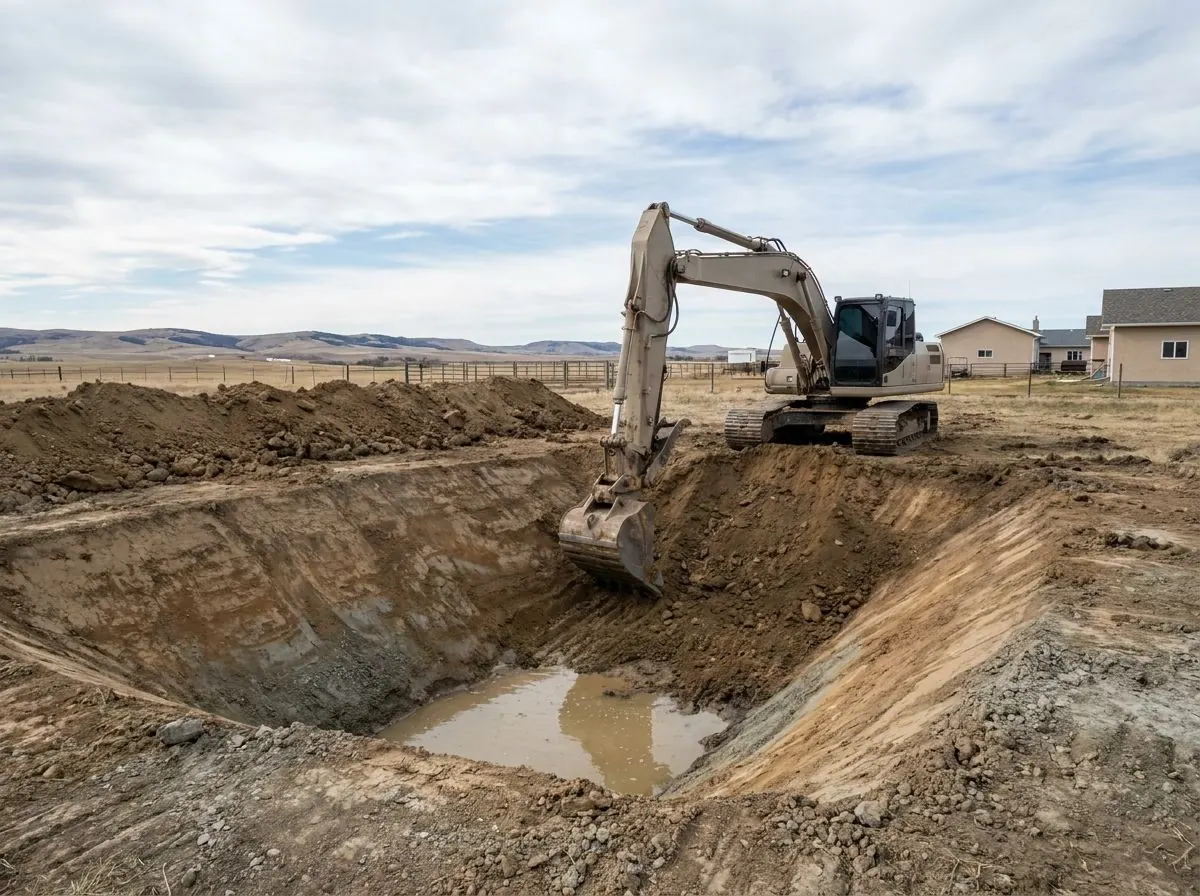
The Problem It Solves
Many dugouts and ponds that fail do so for reasons that were in the ground before the first bucket went in. A seam of sand or gravel a metre below the planned bottom lets the water drain away as fast as spring runoff fills it. A dugout dug too shallow can lose a large share of its useful volume to evaporation in summer and to ice in winter, and Alberta’s own guidance notes that a deeper dugout is more efficient. Sides cut steeper than the soil will stand slump into the water after the first freeze-thaw cycle, shrinking the capacity and leaving a soft, undercut edge.
Then there are the rules. Plenty of acreage owners assume that a hole on their own land is nobody else’s business, and for many ordinary dugouts under Alberta’s Water Act that is close to true, because they are exempt from approval. But the exemption has hard edges. It does not cover a dugout bigger than 7,500 m³, one dug in a wetland or a fish-bearing watercourse, or one that would change the flow of water onto a neighbouring parcel. A purely decorative pond does not obviously fit the regulation’s definition of a dugout, and borrow pits get no exemption at all. Finding that out after the digging is finished leaves an owner seeking authorization for something already built.
The spoil causes its own damage. A dugout moves a great deal of soil, and dumped in the wrong spot it blocks the natural drainage path, pushes runoff onto a neighbour or a driveway, or buries a septic treatment field that nobody marked. On a subdivision or commercial site, a stormwater retention basin that misses its designed volume or outlet elevation does not store the storm it was built for, and the water ends up on downstream lots or roads instead.
How It Works
We start by finding out whether the ground will hold water. Before the dig is priced as final, we put in the test holes the provincial dugout guide calls for, at least five or six spread across the footprint and carried 1.2–1.5 m (4–5 ft) below the proposed bottom, and we log what each one shows: clay, silt, sand or gravel layers, seepage, and anything that will not hold. At the same time we walk the drainage path the pond will draw from and discharge to, mark the well, septic tank and field, and work out the capacity against the 7,500 m³ and 15,000 m³ limits so the size is decided with the rules in view.
The dig follows the shape agreed with the owner or the designer. Depth is set by what the water is for and what the test holes allowed; side and end slopes are cut to what the soil will stand, with historic prairie practice of 1.5:1 sides and 4:1 ends as the starting point unless a design says otherwise. Where test holes show a layer that will not hold water, the choices are to move the pond, stop above the layer, or have a designer specify a compacted clay liner, which we place in thin lifts and compact with a padfoot roller. Inlets and overflow outlets are shaped and armoured with riprap over geotextile so runoff does not cut them away.
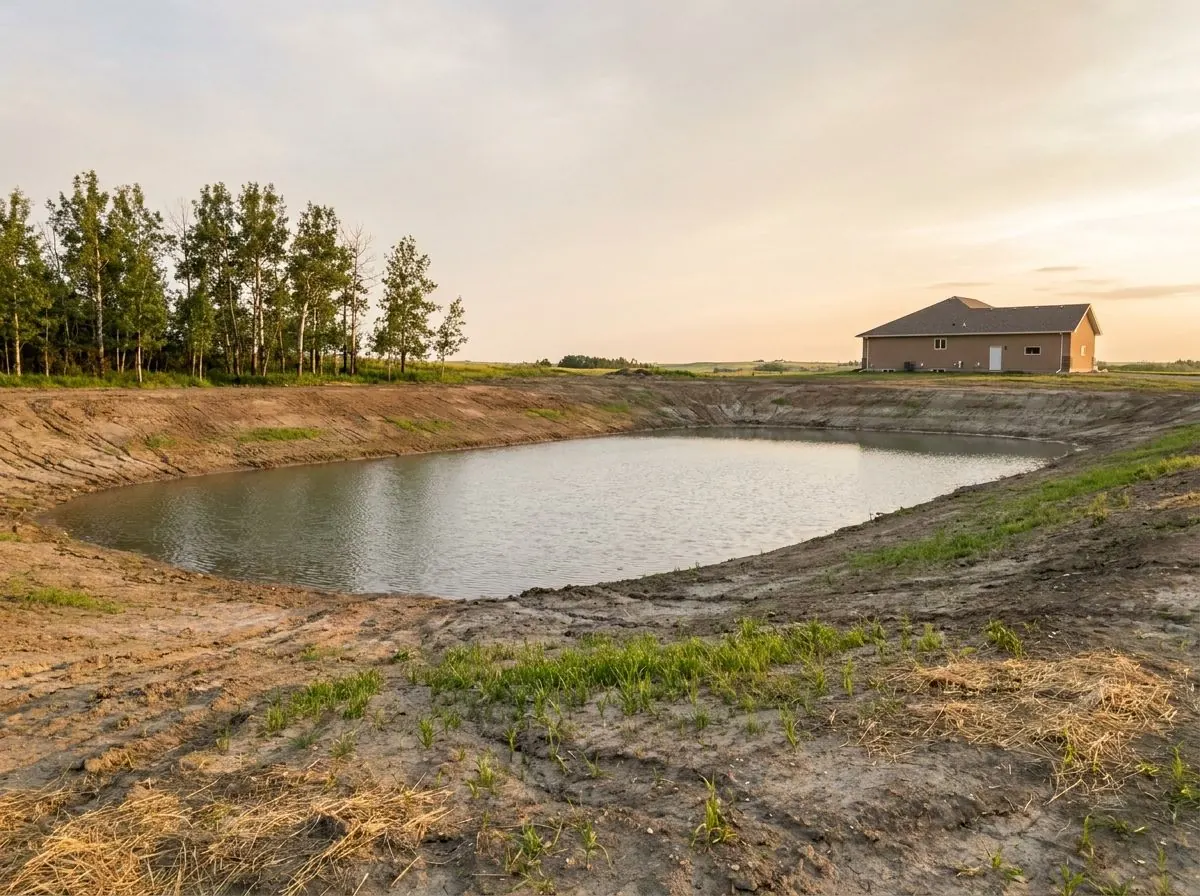
Spoil goes where it does no harm. Topsoil is stripped first and kept aside to dress the finished banks and spoil areas, mineral soil is spread and shaped so it does not redirect water onto an adjacent parcel, and anything the site cannot use is hauled away. Retention basins are dug to the engineered drawings, with the bottom, side slopes, outlet structure and emergency overflow checked by survey against the design volume. The owner ends up with a pond that holds water, sits inside the rules, and has banks that stay where they were cut.
How the Job Runs, Step by Step
Siting, sizing and the rules check
We look at where water will come from, where it will overflow to, and what sits nearby: the well, the septic tank and field, buildings, property lines, wetlands and any creek. Capacity is estimated against the Water Act thresholds of 7,500 m³ for the approval exemption and 15,000 m³ for the licence exemption. If the site is in or next to a wetland or watercourse, or the pond is decorative rather than a dugout, we stop and have the owner confirm the approval path with the province first. Pipelines within 30 m of the dig are checked for, since that brings extra notice and hand-exposure rules.
Locates and test holes
Utility locates are requested, and private lines such as the water line from the well, power to outbuildings and septic piping are marked by the owner or a private locator because the utilities will not mark them. We then dig the test holes, at least five or six across the footprint and 1.2–1.5 m deeper than the planned bottom. Each hole is logged for soil type, water-bearing layers and seepage. If the holes show sand or gravel that will not hold water, we talk through relocating, going shallower or adding a clay liner before any bulk digging starts.
Strip topsoil and dig to shape
Topsoil is stripped from the pond and spoil areas and stockpiled on its own. The excavator digs to the agreed depth and cuts the side and end slopes to the design, working from the rim rather than putting anyone in the excavation. Spoil is kept at least 1 m back from the edge while digging and moved away as the pond deepens so its weight does not load the banks. We check depth and slopes as we go against grade stakes or machine control.
Liner, inlet and outlet work
Where the design calls for a compacted clay liner, suitable clay is placed in thin lifts over the bottom and slopes and compacted with a padfoot roller at a workable moisture. Inlet channels are shaped so runoff enters without scouring the bank, and an overflow spillway or outlet is set at the design water level and armoured with riprap over geotextile. On an engineered retention basin, the outlet structure and control elevation are set exactly to the drawings and surveyed before backfilling around them.
Spoil shaping, topsoil dressing and a safe edge
Spoil is spread and shaped so the land around the pond still drains the way it did, or the way the design intends, and does not send water onto a neighbouring parcel. Stripped topsoil goes back over the banks and spoil areas so they can be seeded and stop eroding. Surplus soil is loaded out if the site cannot take it. We leave the owner with a clear sense of where the steep sides are and where the gentler end slope gives people and animals a way out of the water.
Equipment on This Job
Full-size excavator, roughly 10 t and up
Digs the test holes, strips topsoil, excavates the bulk of the dugout from the rim and trims side and end slopes to shape. The reach and bucket size of a full-size machine is what makes a deeper dugout practical without putting the machine on an unstable bank.
Compact track loader
Spreads and shapes spoil away from the pond, builds low berms where the design calls for them and places topsoil back over the banks. Its low ground pressure lets it work on pasture and wet ground around a pond without rutting the land it is meant to leave tidy.
Padfoot roller
Compacts clay in thin lifts where a pond needs a liner over a leaky layer, or where an embankment or berm has to hold water. The pads knead cohesive clay from the bottom of each lift up, which a smooth drum cannot do on this material.
Tandem and tri-axle dump trucks
Haul surplus spoil off sites that cannot absorb it, which is often the case on smaller acreage parcels, and bring in riprap and any imported clay. On Rocky View County roads, hauling can need a road use agreement or permit, which we sort out before trucks roll.
What Decides the Specification
Purpose sets the size and depth. A livestock dugout is sized to the herd and the months it has to last; a decorative pond is shaped for appearance and safety at the edge. Depth matters more than people expect: Alberta’s dugout guide says a deeper dugout is more efficient, since a shallow one typically gives up more of its volume to evaporation and ice, and it notes newer, larger dugouts being dug to about 4.6–6.4 m (15–21 ft). Where the water comes from matters too: a pond filled by spring runoff behaves differently from one topped up by pumping, and pumping water in changes whether the licence exemption applies.
The test holes decide the rest. Clay that holds water lets the dugout be dug to the shape planned; a sand or gravel layer, a wet seam or high seepage changes the depth, the location or the need for a compacted clay liner. Soil type also sets how steep the banks can safely be cut, and softer or sandier material needs flatter slopes than the historic 1.5:1. For a stormwater retention basin, the engineer’s design governs every dimension: the storage volume, the bottom and top-of-bank elevations, the outlet control, the overflow route and the side slopes, and our job is to build that surface accurately and prove it by survey.
Code, Safety and Permit Notes
Under Alberta’s Water (Ministerial) Regulation, a dugout is an excavation that holds water for agricultural use, such as raising animals, watering gardens, crop production or applying pesticides, or for household purposes. Such dugouts are exempt from Water Act approval unless, among other exceptions, the dugout is in a fish-bearing watercourse, lake or wetland, is in a reserved area, would change the flow of water on an adjacent parcel, has a capacity greater than 7,500 m³, or sits in the same watercourse and parcel as an existing dugout. Using the water needs no licence unless water is pumped in, capacity is over 15,000 m³ or diversion exceeds 7,500 m³ a year. Borrow pits get no exemption. That is our reading; confirm with the province before digging.
Stormwater retention basins are typically engineered and approved by the municipality or the province, and we build them only to an engineer’s design. Erosion and sediment control applies to the disturbed area: Rocky View County scales it from a Good Housekeeping letter under 0.4 ha to ESC drawings and written notice over 2.0 ha. Any outlet or ditch work in a County right-of-way needs County permission first. Foothills County states that no construction, including excavation, may take place without a permit, so ask the County whether that reaches your pond. Under the OHS Code, workers do not enter an excavation deeper than 1.5 m without sloping or protection, spoil stays at least 1 m back, and a pipeline found within 5 m of the dig is exposed by hand.
General guidance only. The municipality, Alberta’s safety codes and the engineer of record, where there is one, decide what applies to your job.
Around Calgary
Bearspaw, in Rocky View County, spans parts of three drainage catchments, Big Hill Springs Creek, Nose Creek and the Bow River, and its area structure plan speaks directly about slopes, coulees, wetlands and riparian areas. That is exactly the ground where a dugout needs checking before it is dug: a low spot that looks like the natural place for a pond may be a wetland, where the dugout exemption does not apply, and a coulee bottom may carry runoff that a pond and its spoil would push onto the next parcel. The plan sets agricultural parcels at a minimum of 14.2 ha (35 acres), and parcels of that size are where a livestock dugout is more likely to fit.
Springbank, also in Rocky View County, has twelve stormwater catchment areas, five flowing north to the Bow River, and many comprehensively planned two-acre subdivisions in a community that has historically relied on groundwater wells, private water co-operatives and septic fields. On a two-acre lot, a decorative pond competes for space with the well, the septic tank and the treatment field, and spoil has very few places to go, so hauling is often part of the job. South of the city, around De Winton in Foothills County, the traditional acreages can be big enough for a dugout, but the County’s own permit statement means the conversation with the County comes before the dig.
Often Done Alongside
Slope Stabilization & Erosion Control
Runoff diversion, benching, riprap, silt fence and revegetation on slopes and banks.
Culvert Installation & Ditch Re-Grading
Acreage driveway culverts, approach approvals, riprap ends and ditch re-grading.
Site Clean-Up & Material Haul-Off
Dirt, clay, rock and debris sorted, hauled off and the site left clean.
Where We Do This Work
Calgary, quadrant by quadrant
Acreage country
Neighbouring cities and towns
Ponds, Dugouts & Basins: Questions We Get
How deep should a dugout be?
Do I need Water Act approval to dig a dugout in Alberta?
Can I top up my dugout by pumping water into it?
Who designs a stormwater retention basin, and what do you build?
Can excavation be done in a Calgary winter?
Get a Written Estimate for Ponds, Dugouts & Basins
Send the basics and we will come back with questions or a time to look at the site. Drawings, a geotechnical report or photos of the access all help.
Considering Ponds, Dugouts & Basins?
Call Aspen Excavating or send the details. We will look at the site, tell you whether ponds, dugouts & basins is the right scope, and price it in writing.