Springbank Acreage Excavation Between the Bow & Elbow
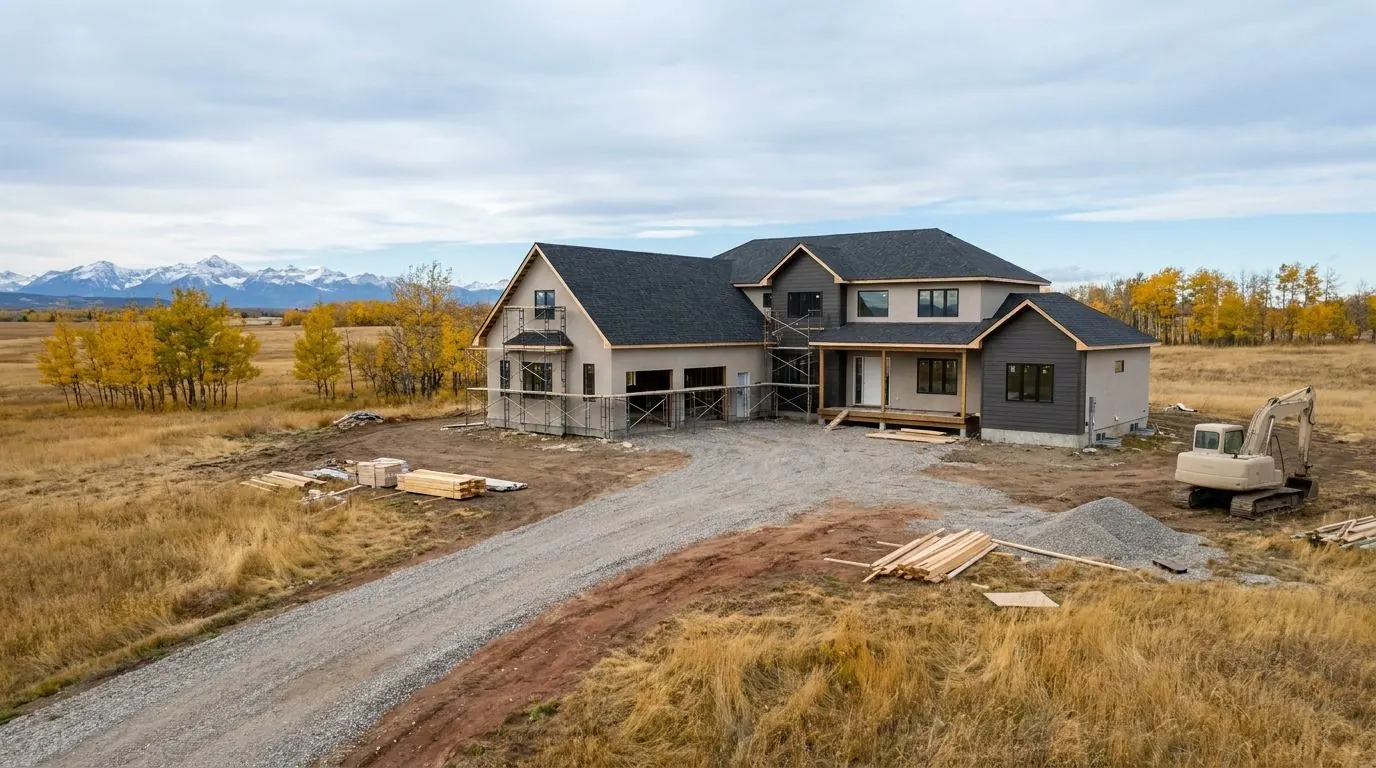
Springbank, in Rocky View County, is country residential land between the Bow River and the Elbow River, about 20 km west of downtown Calgary. Much of it is laid out in planned two-acre subdivisions, and its water and sewer have long come from wells, co-ops and septic fields, so on many lots the basement is only one of several holes the build needs. We plan the basement dig, the septic excavation, the service trenches and the driveway as one site, in the order the permits and the ground allow.
At a Glance
- Municipality
- Rocky View County
- From our downtown office
- About 30 minutes west, via Highway 1
- Typical servicing
- Wells, water co-ops and septic fields, with some piped servicing
- Postal prefixes
- T3Z
Lots, Homes and Sites in Springbank
Rocky View County's Springbank Area Structure Plan describes many parts of the community as comprehensively planned two-acre subdivisions, and it sets the minimum parcel size at about 0.8 ha (1.98 acres). The County notes that Springbank started to attract rural residential living in the 1950s, so an older acreage house with its original well and field can sit beside a new custom build. An open parcel gives room to work: we strip and stockpile topsoil, dig a full basement with over-dig for the footing forms, and keep suitable spoil on site for backfill instead of trucking it away.
Water and sewer are what make Springbank different from a city lot. The ASP says the community has historically relied on groundwater wells, private water cooperatives and septic fields, and the County's Municipal Development Plan describes piped servicing through private water co-ops alongside wells and septic systems. A new house therefore needs a water line trench from the well or the co-op connection, a sewer line to the septic tank, and a tank and treatment field excavation laid out to a certified installer's design. Every trench is routed around the setbacks in the 2021 Alberta Private Sewage Systems Standard of Practice, which keeps a treatment field 15 m from a well and 10 m from a basement.
The long driveway is the other constant. A two-acre parcel set back from a county road needs a stripped, built-up gravel driveway that will carry a loaded concrete truck in a wet spring, plus an approach with a culvert where the road ditch calls for one. We rough in the driveway before the basement dig so every trade that follows can reach the house pad without rutting the lot. Harmony is the exception: a master-planned Growth Hamlet outside the Springbank ASP with piped servicing, where a lot needs service trenches to the mains instead.
Neighbourhood Notes
Harmony
A master-planned Growth Hamlet in the Springbank area, outside the Springbank ASP, with piped servicing. Work here is basement digs and service trenches to the mains on serviced lots, not well lines and septic fields.
The Bow River side
The Bow River forms the plan area's northeast edge, and five of Springbank's twelve stormwater catchments drain north to it. Grading, driveway ditches and dugout spoil on these parcels have to send water the way the catchment already runs.
Toward the Elbow River
The Elbow River bounds Springbank to the south. A parcel on this side may sit in a different catchment from lots farther north, so confirm where its water goes before borrowing a grading plan from across the community.
Highway 1 corridor
Highway 1 runs east to west through the plan area and is the most direct route for our floats and dump trucks. Once loads leave the highway for County roads, the County's Servicing Standards can require a road use permit or agreement.
Lower Springbank Road
Named in the Springbank ASP. On an older acreage off a road like this, a rebuild or addition usually means working around an existing well, tank and field that must stay in service until the new system is ready.
Highways 8 and 22
The County's plan lists access to Highway 8 and Highway 22 as well as Highway 1 and Stoney Trail. A parcel reached from a highway-side road generally needs its driveway and approach culvert built before the basement dig.
Old Banff Coach Road
Highway 563, Old Banff Coach Road, is mapped close to the Springbank area. For acreages near it, settle which road the approach comes off before we build the driveway, since new approaches are inspected by the County.
Permits and Locates in Springbank
Authority having jurisdiction: Rocky View County
Rocky View County is the permit authority for Springbank, for the building permit and for the private sewage permit that a certified installer obtains; the County's full sequence, including the inspection before a septic system is backfilled, is set out on our Rocky View County page. What changes on a Springbank acreage is the locate. Utility-owned lines are marked at no charge once a request reaches Utility Safety Partners, with a minimum of three full working days' notice and more when the season is busy. A private well line, the septic tank and field, and a power run from the house to a shop are customer-owned, so the utility will not mark them; we arrange a private locate or expose them by hand.
The Excavation Work Springbank Calls For Most
Septic System & Field Excavation
Test pits, tank holes and treatment field trenches for acreage septic systems.
Deep Basement Excavation
Full and walkout basement digs for new custom homes on open lots and acreages.
Driveway & Access Road Rough-In
Acreage driveways and access roads built on geotextile and crushed gravel.
Culvert Installation & Ditch Re-Grading
Acreage driveway culverts, approach approvals, riprap ends and ditch re-grading.
Deep Utility Trenching (Water, Sewer & Storm)
Shored, bedded trenches for water, sanitary and storm service lines.
Pond, Dugout & Retention Basin Digging
Acreage dugouts, ponds and engineered stormwater basins, dug from test holes up.
Close to Springbank
Inner-city infills in Altadore and South Calgary out to the newer west-side communities.
Country residential acreages northwest of Calgary, between Highway 1A and Cochrane.
A Bow River town west of Calgary, with kettle terrain and slopes mapped in Rivercrest.
Growth hamlets, country residential communities and farmland beside Calgary.
Excavation in Springbank: Questions
Is Springbank a hamlet, or part of Calgary?
Can you dig the basement and the septic field on the same Springbank acreage job?
Our Springbank lot is on a water co-op, not a well. What changes?
Digging in Springbank?
Call or send the details. Aspen Excavating works from downtown Calgary, and we will look at the site and the access before we price it.