Driveway & Access Road Rough-In in Calgary
We build acreage driveways and site access roads from the ground up: lay out the alignment, strip the topsoil, compact the subgrade, roll out geotextile, and place crushed gravel sub-base and top course with a crown and ditches that shed water. Built to carry the build traffic and last beyond it.
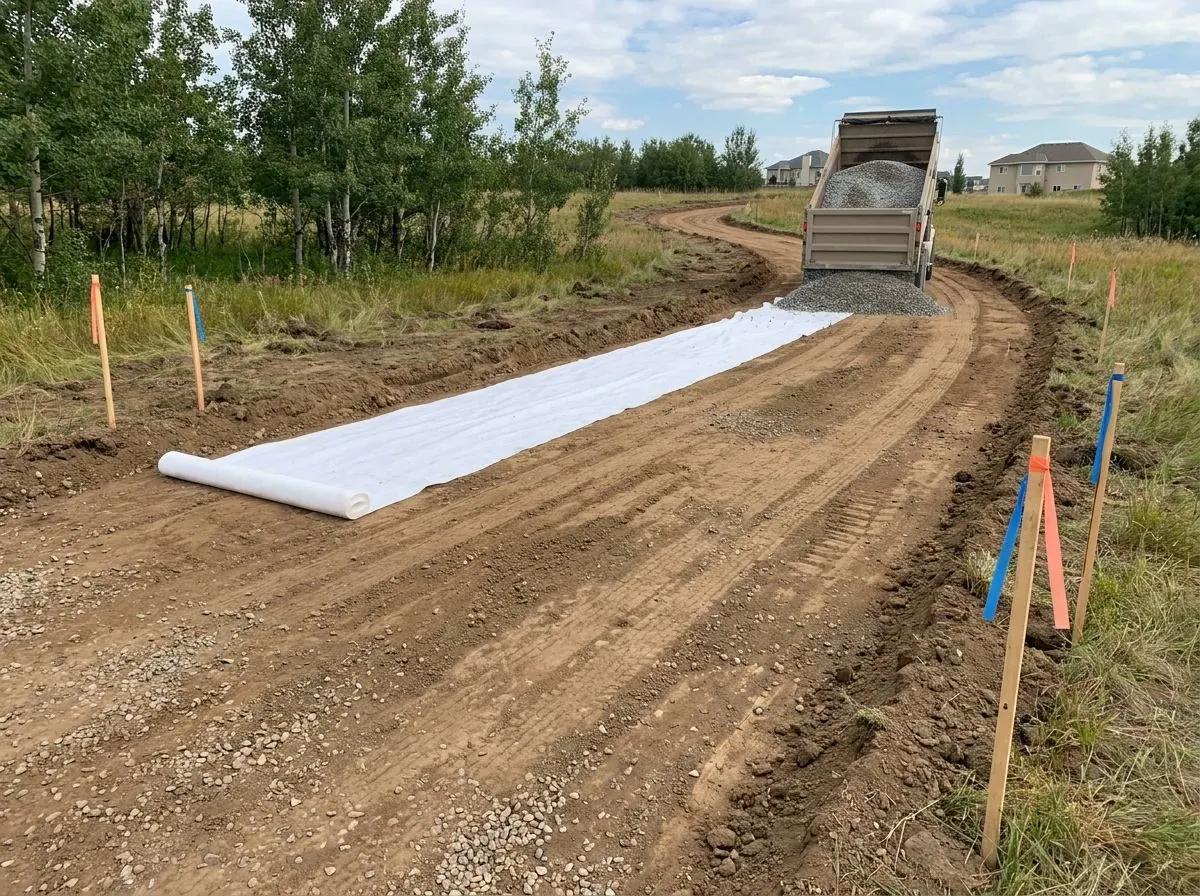
The Problem It Solves
An acreage driveway gets its hardest use before anyone moves in. Excavators, concrete trucks, pump trucks, lumber deliveries, septic tanks and well rigs all travel the same strip of ground while the house goes up. Build that strip as a scrape of gravel over topsoil and it fails under the first wet week: ruts deep enough to high-centre a pickup, trucks stuck on the lane, and deliveries refused at the road. The build stalls while someone dumps more gravel into mud that simply swallows it.
The failures that follow are slower but just as expensive. Gravel spread directly on soft clay is gradually pushed down into the soil by traffic and frost, so each spring the driveway needs another load and still ruts. A flat surface with no crown lets water sit on top and soak in, and a driveway built lower than the land beside it becomes the drainage channel for the whole yard. In a place where the ground freezes deep, water trapped in the road base heaves in winter and turns to mush during the spring thaw.
Access roads also cross things people forget are there. Acreage septic fields, water wells and power lines run to a shop are private and are not marked by the utility locate service. Rural parcels can carry pipeline rights-of-way. And the point where the driveway meets the public road is not the owner’s to change freely: in Rocky View County, a new or upgraded approach needs County approval and inspection. A driveway laid out without checking those three things can end up dug up, rerouted or rebuilt.
How It Works
We build the driveway as a small road, not a gravel path. The alignment is set out first to follow the land sensibly: avoiding low wet areas, keeping grades manageable for loaded trucks, staying clear of septic fields and wells, and giving delivery trucks room to turn at the house end. Topsoil is stripped along the whole corridor and stockpiled for landscaping, because organic soil left under gravel compresses and ruts. The exposed subgrade is shaped, compacted and proof rolled with a loaded truck, and soft spots are dug out and rebuilt before any gravel goes on.
Separation keeps the gravel where it belongs. Where the subgrade is clay, silt or otherwise soft, we roll out geotextile separation fabric over the compacted subgrade before the first granular layer. The fabric stops the gravel from being pushed down into the soil and the fines from pumping up into the gravel, so the full thickness of the road base stays intact season after season. On top go a granular sub-base for strength and a crushed gravel top course for a tight, interlocked driving surface, each placed in lifts and compacted with a smooth-drum roller.
Then we shape it to shed water. The finished surface is crowned or cross-sloped so rain and snowmelt run off rather than soaking in, and the driveway is built slightly above the ground beside it, with side ditches or grassed swales carrying the water away from the road base and away from the house. Where the driveway meets the public road, we build the approach to the County’s approved layout and grade; if a culvert is needed under the approach, our culvert installation work covers the pipe, bedding and ends.
How the Job Runs, Step by Step
Lay out the route and check approvals
We walk the proposed route with you and stake the alignment, width, turnaround and any parking pad. Utility locates are requested, and the owner or a private locator marks wells, septic fields and private power. Where the driveway meets a County road, the approach application and inspection are sorted before construction reaches the road.
Strip the corridor and cut to subgrade
Topsoil is stripped along the full width of the driveway and its ditches and stockpiled for landscaping. The route is then cut and filled to its subgrade profile so the finished surface will sit slightly above the land beside it. Unsuitable soft or organic material is removed rather than buried.
Compact, proof roll and repair the subgrade
The subgrade is compacted in lifts and proof rolled with a loaded truck to find soft spots. Any area that ruts or pumps is dug out and rebuilt with compacted granular material. Skip this step and a hidden soft spot can turn into a rut or a sinkhole in the driveway’s first spring.
Place fabric, sub-base and top course
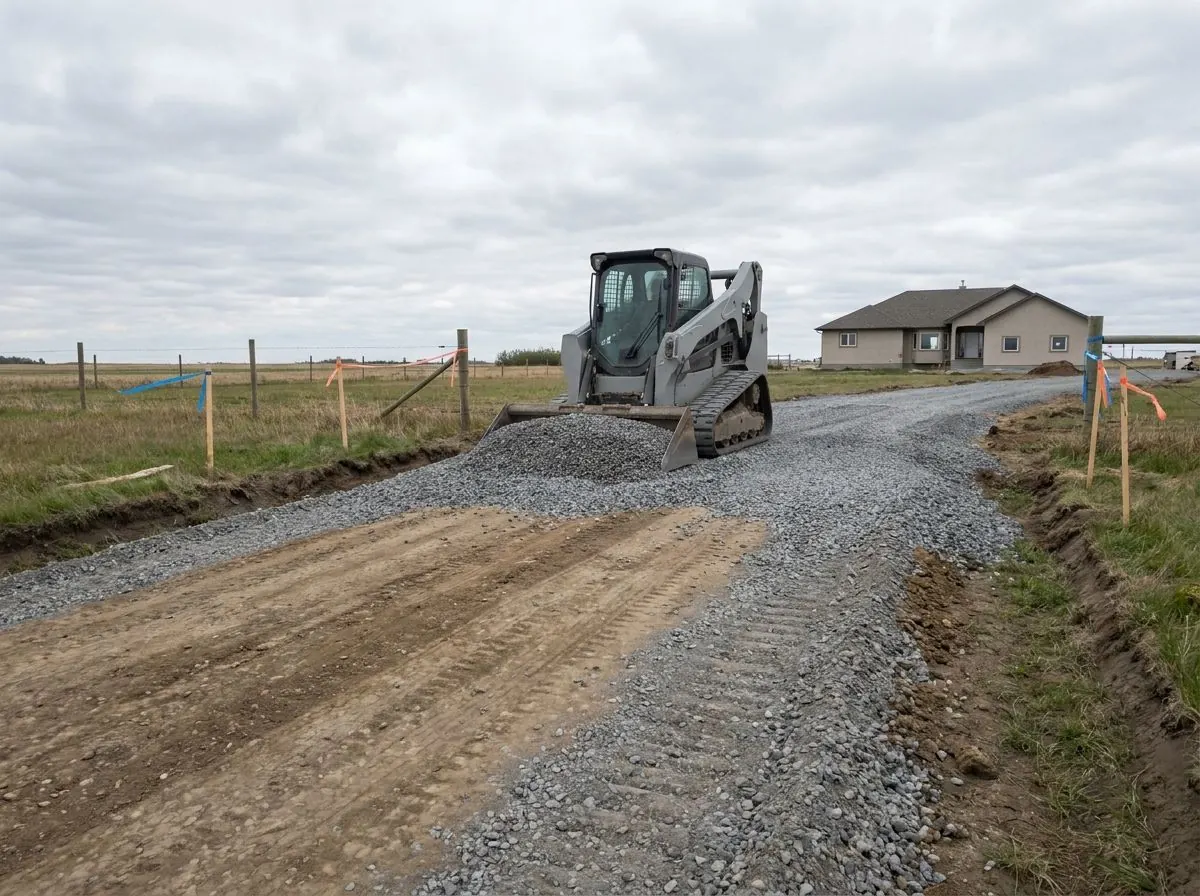
Geotextile separation fabric is rolled out over the prepared subgrade with generous overlaps where the soil calls for it. Granular sub-base is spread in lifts and compacted, then crushed gravel top course is placed and rolled tight. Each layer is shaped to the finished crown or cross-slope as it goes on.
Shape the crown, ditches and approach
The final surface is trimmed to its crown so water runs to the edges, and side ditches or swales are cut to carry runoff away. The approach is built to the approved layout and grade and left ready for the County’s completion inspection. Topsoil is spread back along the shoulders to be seeded.
Equipment on This Job
Full-size excavator
A full-size excavator, roughly above 10 t, strips the corridor, cuts the route to its subgrade profile, digs out soft spots and shapes side ditches to a consistent grade. On acreage ground with rolling terrain, it also handles the cut and fill that keeps the driveway at a manageable slope for loaded trucks.
Dozer or compact track loader
A dozer spreads sub-base and gravel in even lifts along the length of a longer driveway and pushes it to the crown profile. A compact track loader takes the finish work, turnarounds and approach, and works close to the house, well and septic field without rutting the prepared surface.
Smooth-drum vibratory roller
The roller compacts each granular lift, from the sub-base to the crushed gravel top course, into a dense, interlocked layer. It also seals the finished surface so water runs off to the ditches instead of soaking into the road base, which is what keeps a gravel driveway from rutting in spring.
Tri-axle dump trucks
Tri-axles bring in sub-base and crushed gravel in fewer, larger loads, which matters on long acreage driveways far from the pit. In Rocky View County, hauling on County roads may need a road use agreement or permit, so we check that before the gravel trucks start rolling.
What Decides the Specification
The subgrade decides the build-up. A firm, well-drained granular subgrade can carry a driveway with a modest granular section, while soft clay or silt needs geotextile separation, a thicker sub-base, or soft spots dug out and replaced before any gravel is placed. Moisture matters: wet clay has to be dried or replaced before it will compact. How much traffic the driveway must carry sets the rest. A lane that only sees family vehicles once the house is built still has to survive concrete trucks, pump trucks and deliveries during construction, so we build for the heaviest traffic it will see, not the lightest.
The materials are chosen for their job in the road. Geotextile separation fabric sits between soil and gravel to keep the layers apart; it is typically used over fine-grained or soft soils and is not a substitute for proper compaction. The sub-base is a coarser granular layer that spreads loads and drains. The top course is crushed gravel, whose angular, fractured particles lock together under the roller far better than rounded stone. The City of Calgary Roads specification, a useful benchmark, limits granular lifts to 300 mm and calls for base and sub-base compacted to at least 98% of maximum dry density. Length, slope, the approach and the ditch outlets decide the rest.
Code, Safety and Permit Notes
In Rocky View County, County permission is required for any work within County rights-of-way, road allowances or easements, including installing, altering or removing a culvert. New and upgraded road approaches go through a Road Approach Application, and the County inspects the location in advance and again at completion. The County’s Servicing Standards set a maximum approach grade of 4% and say a culvert is typically required unless the approach sits at a high point. Hauling on County roads may need a road use agreement or permit. In Foothills County and other municipalities, approach rules come from that municipality, so we confirm them before starting. Inside Calgary, digging into a City road right-of-way needs an Excavation Permit.
A driveway is ground disturbance, so utility locates come first, with at least 3 full working days’ notice and longer in busy season. Private facilities are the owner’s to identify: septic tanks and fields, water wells and power run to outbuildings are not marked by the utility. Under Alberta’s Pipeline Rules, anyone disturbing ground must check for pipelines within 30 m of the work and notify Utility Safety Partners before work in a pipeline controlled area, which extends 30 m either side of the centreline, and must hand-expose a pipeline once work comes within 5 m. Where a driveway crosses a pipeline right-of-way, we involve the operator before any machine works there.
General guidance only. The municipality, Alberta’s safety codes and the engineer of record, where there is one, decide what applies to your job.
Around Calgary
Springbank, in Rocky View County, is typical of the ground these driveways are built on. The Springbank Area Structure Plan describes many comprehensively planned two-acre subdivisions, with a minimum parcel size of about 0.8 ha, historically serviced by private wells, water co-ops and septic fields, and it identifies twelve stormwater catchment areas, five flowing north to the Bow River. That means long driveways laid out around a septic field and a well, crossing land that drains somewhere specific. We align the driveway to respect both, and ditch it so runoff follows the natural drainage rather than cutting a new path through a neighbour’s parcel.
South of the city, Foothills County’s development plan describes country residential lots as traditional acreage lots, and says individual wells and septic systems are appropriate in some instances. De Winton, a Foothills County hamlet on the Highway 552 and Macleod Trail corridor, is surrounded by traditional acreages, and on a lot like that a driveway can be a long private lane serving a house, shop and outbuildings from a county road. Foothills County states that no construction, including foundation or excavation, takes place until a permit has been issued, so on a new build the driveway rough-in is timed with the permit and serves as the construction access for everything that follows.
Often Done Alongside
Culvert Installation & Ditch Re-Grading
Acreage driveway culverts, approach approvals, riprap ends and ditch re-grading.
Subgrade Compaction & Proof Rolling
Lift-by-lift compaction, loaded-truck proof rolling and soft-spot repair.
Land Clearing & Vegetation Removal
Brush, trees, stumps, roots and boulders removed; mulched or hauled away.
Where We Do This Work
Calgary, quadrant by quadrant
Acreage country
Neighbouring cities and towns
Driveway Rough-In: Questions We Get
How thick should the gravel be on an acreage driveway?
Do I really need geotextile fabric under my driveway?
What approvals do I need to connect a driveway to a Rocky View County road?
Should the driveway go in before we start building the house?
How do I know the backfill and grading were done right?
Get a Written Estimate for Driveway Rough-In
Send the basics and we will come back with questions or a time to look at the site. Drawings, a geotechnical report or photos of the access all help.
Considering Driveway Rough-In?
Call Aspen Excavating or send the details. We will look at the site, tell you whether driveway rough-in is the right scope, and price it in writing.