Subgrade Compaction & Proof Rolling in Calgary
We compact subgrade the way the soil demands: padfoot rollers on clay, smooth drums on granular fill, thin lifts at the right moisture. Then we proof roll with a loaded truck, dig out the soft spots it finds, and have the ground ready for independent density testing before gravel or concrete goes down.
The Problem It Solves
A driveway, a shop floor or a parking area is only as good as the ground under it. Loose soil keeps settling after the concrete or gravel is placed, and it rarely settles evenly. The result is the familiar list of failures: slabs that crack along a line where the fill changed, gravel driveways that rut in the wheel paths every spring, pavement that sinks into a birdbath over a buried soft spot, and garage floors that pull away from the foundation wall. By the time those failures show, the surface has to come out to fix the ground beneath it.
Compaction goes wrong in predictable ways. Thick lifts get rolled from the top, so the upper layer looks tight while the bottom half stays loose. Clay gets compacted too wet and turns into a spongy mass that pumps under a wheel, or too dry and never reaches density at all. The wrong machine is used, such as a smooth vibratory drum on sticky clay, which bridges over the surface without kneading the soil below. And soft pockets of organic or saturated soil stay hidden because nobody drove a heavy load over the finished grade to find them.
Calgary’s climate magnifies every one of those mistakes. Frost goes deep here: the normal frost depth has been reported as about 2 m (7 ft), and in the extreme winter of 2019 it reached 2.4 m (8 ft). Poorly compacted soil holds more water, and water in the ground freezes, expands and heaves, then thaws into a weak, saturated layer each spring. A subgrade that was never properly compacted gives way under the next heavy load, and it keeps doing so year after year.
How It Works
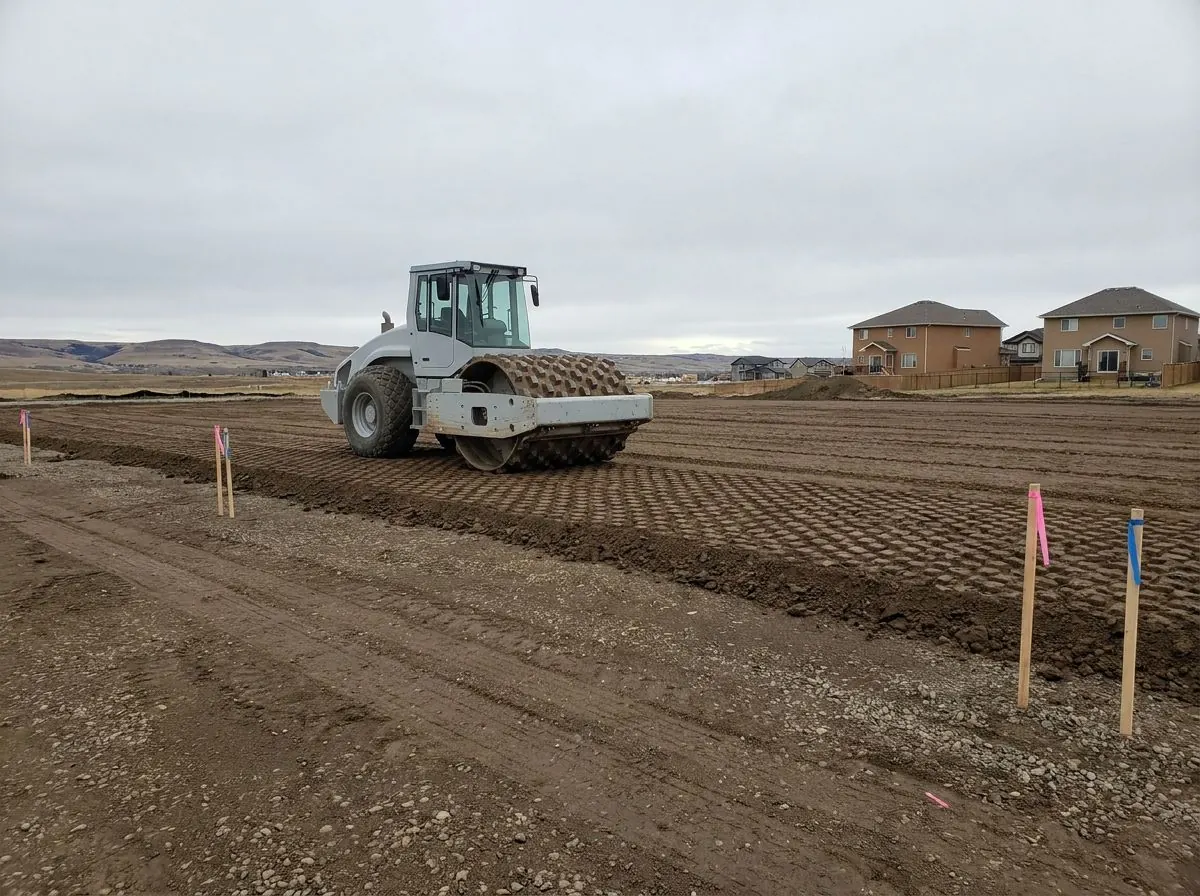
We match the method to the soil. Cohesive clays and silts are compacted with a padfoot roller, whose feet push into each lift and knead it from the bottom up, driving out air and working the particles together. Granular materials such as pit-run and crushed gravel are compacted with a smooth-drum roller, usually vibrating, which rearranges the particles into a dense, interlocked layer and leaves a tight finished surface. Next to walls, around structures and in confined spots we switch to vibratory plates on granular material and rammers on cohesive soil, in thinner layers.
We build in thin lifts at the right moisture. Compaction only works when the lift is thin enough for the roller’s energy to reach the bottom, which is why the City of Calgary Roads specification caps soil lifts at 200 mm and granular lifts at 300 mm. Moisture matters just as much: every soil reaches its greatest density at a particular water content, found in the laboratory by a Standard Proctor test. Dry soil is watered and mixed; wet clay is spread, worked and allowed to dry, or replaced. We don’t compact frozen material or place frozen fill.
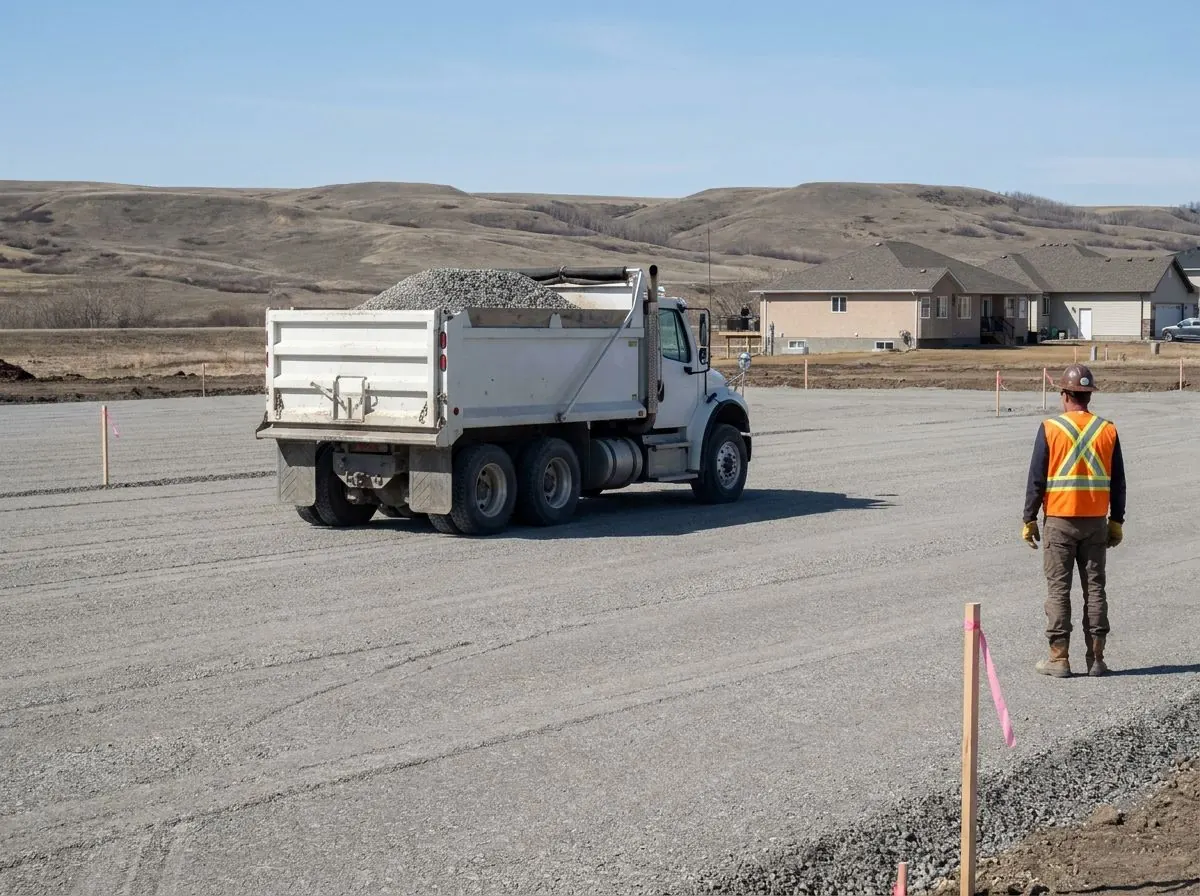
Then we prove it. On the finished subgrade we run a proof roll with a fully loaded truck over the whole area in overlapping passes, while someone watches the surface for rutting, weaving and pumping. That test finds what a density test between spots can miss: a buried soft pocket, a wet seam or an old organic layer. Soft spots are sub-excavated to firm ground, backfilled with compacted granular material, over a geotextile where the design calls for it, and rolled again. Independent density testing then confirms the numbers before gravel, forms or concrete go down.
How the Job Runs, Step by Step
Identify the soil and the target
We review the drawings, the geotechnical report if there is one, and the specified density and lift thickness for each layer. On site we check what the subgrade actually is, clay, silt or granular, and how wet it is. That decides the roller, the lift thickness and whether the soil needs drying, wetting or replacing.
Prepare and condition the subgrade
Topsoil and organic material are removed to firm mineral soil. In cut areas, the exposed subgrade is scarified and brought to a workable moisture before it is recompacted. Surface water is drained away from the work area so rain does not undo the conditioning overnight.
Place and compact in lifts
Fill is spread in lifts no thicker than the roller can compact through, and each lift is rolled in overlapping passes until it stops moving under the drum. Padfoot rollers work clay and silt; smooth drums work granular material and the final surface. Edges, corners and areas beside structures are finished with plates or rammers in thinner layers.
Proof roll the finished grade
A loaded truck is driven across the finished subgrade in a pattern that covers the whole area, while we watch for rutting, weaving or pumping. Any soft spot is marked on the ground. Where the engineer calls for the City Roads method, the test vehicle carries an 8,200 kg axle load.
Repair soft spots and hand over for testing
Marked soft spots are dug out to firm ground, lined with geotextile where specified, backfilled with compacted granular material and proof rolled again. The independent testing firm or geotechnical engineer then takes density tests and confirms the result. Only after sign-off does the next layer, gravel, formwork or concrete, go on.
Equipment on This Job
Padfoot (sheepsfoot) roller
The padfoot roller is the tool for clay and silt. Its protruding feet penetrate each lift and knead the soil from the bottom of the layer upward, which a smooth drum cannot do on cohesive ground. As the lift densifies, the feet walk out toward the surface, a visible sign the layer is tightening.
Smooth-drum vibratory roller
On pit-run, crushed gravel and other granular layers, a smooth drum with vibration shakes the particles into a dense, interlocked structure. It is also used to seal and finish the final surface of the subgrade or base course so rain runs off instead of soaking in before paving or pouring.
Vibratory plate and rammer
Where a roller cannot reach, beside foundation walls, around catch basins and in narrow strips, we compact by hand-operated machine. Vibratory plates suit granular materials; rammers, sometimes called jumping jacks, suit cohesive soils and confined spaces. Both work in thin lifts, and the City Roads spec limits hand-tamped layers accordingly.
Loaded tandem or tri-axle dump truck
For proof rolling, a fully loaded dump truck is the test load. Driven across the finished subgrade at walking pace, its tires reveal rutting, weaving and pumping that show where the ground is soft. Where a specification calls for a defined test vehicle, we load the truck to the stated axle weight.
What Decides the Specification
Soil type drives almost every decision. Clay and silt hold water, compact best close to their optimum moisture content and need kneading, so they get padfoot rollers and thin lifts. Granular soils drain freely and respond to vibration, so they get smooth drums and can be placed in somewhat thicker lifts. Mixed or variable soil is compacted to suit its most difficult component. The target itself comes from the Standard Proctor test (ASTM D698), which finds the maximum dry density a soil can reach and the moisture at which it gets there; field density is then expressed as a percentage of that maximum. For comparison, the City of Calgary’s utility trench backfill specification asks for soil moisture from optimum to 2% above it.
The load above sets the target. Under the City of Calgary Roads Construction specification, which is still the edition the City links for road contractors, subgrade fill is compacted to 97% of maximum density, cut subgrade is scarified 150 mm and recompacted to 97%, and granular base and sub-base reach at least 98%. Those figures were written for City roads and road embankments, so on a house pad or a private yard they are a benchmark, not a rule. Private driveways, shop floors and yards may have lower or project-specific targets set by the engineer or designer. Where the subgrade is soft or wet, the design may add sub-excavation, a geotextile separation layer, or a thicker granular section, all of which change the materials and the rolling plan.
Code, Safety and Permit Notes
The most useful public benchmark for subgrade work around here is the City of Calgary Roads Construction 2021 Standard Specifications. It sets maximum lift thicknesses of 200 mm for soil and 300 mm for granular material, 97% of maximum density for soil embankment and subgrade fill, at least 98% for granular base and sub-base, and hand-tamped layers no thicker than 200 mm loose, or 100 mm within the top 600 mm. It describes proof rolling with a loaded test vehicle carrying an 8,200 kg axle, used when the engineer requires it. City sewer specifications reference ASTM D698 for Standard Proctor density and ASTM D2922 for field density testing.
Those figures apply to City road and utility work; private projects follow whatever the engineer, geotechnical report or building designer specifies, which may be the same or different. On structural work, density is typically verified by an independent testing firm or the geotechnical engineer, and they, not the compaction contractor, sign off the result. City specifications are clear that frozen material is not used for backfill, and the National Building Code 2023 Alberta Edition requires excavation bottoms for foundations to be kept from freezing. Where compaction happens inside a trench deeper than 1.5 m, Alberta OHS Code protection rules apply to anyone working in it.
General guidance only. The municipality, Alberta’s safety codes and the engineer of record, where there is one, decide what applies to your job.
Around Calgary
Calgary’s industrial districts are where compaction is tested hardest. In places such as Shepard Industrial and Great Plains in the southeast, or the Stoney districts near the airport in the northeast, yards, laydown areas and shop floors carry loaded trucks, forklifts and heavy equipment every day. A subgrade that was rolled from the top in one thick lift, or never proof rolled, can show up under that kind of traffic as rutted gravel yards and cracked floor slabs. On that kind of work we build to the project’s specified densities and leave the ground ready for the testing firm’s sign-off.
North of the city, Airdrie shows how wet ground changes the job. The City of Airdrie’s own history notes that the area around Nose Creek was often wet and prone to seasonal flooding, and in 2025 the city issued 1,623 permits for new homes. When lots and driveways are built at that pace, some of the work inevitably lands on ground that is wet after rain or spring melt, and that subgrade has to be conditioned to the right moisture before it can be compacted at all. Rolling wet clay only pumps it. We dry, rework or replace the soil, and use geotextile over soft spots, before granular layers go on.
Often Done Alongside
Mass Earthworks & Site Grading
Cut and fill, topsoil stripping and laser or GNSS grading to design elevations.
Commercial Pad Prep & Parking Lot Excavation
Building pads and parking lot subgrades built in tested lifts to civil drawings.
Driveway & Access Road Rough-In
Acreage driveways and access roads built on geotextile and crushed gravel.
Where We Do This Work
Calgary, quadrant by quadrant
Acreage country
Neighbouring cities and towns
Compaction & Proof Rolling: Questions We Get
What does 97% Standard Proctor actually mean?
What is proof rolling and why is it done?
When is geotextile fabric needed under gravel?
Who does the compaction testing, and can you do it?
Who handles utility locates and permits?
Get a Written Estimate for Compaction & Proof Rolling
Send the basics and we will come back with questions or a time to look at the site. Drawings, a geotechnical report or photos of the access all help.
Considering Compaction & Proof Rolling?
Call Aspen Excavating or send the details. We will look at the site, tell you whether compaction & proof rolling is the right scope, and price it in writing.