Infill Lot Digging & Tight-Access Excavation in Calgary
On a narrow inner-city lot, the neighbours' houses decide how you dig. We excavate Calgary infill lots with zero-tail-swing mini and midi machines, work to the engineer's shoring plan beside neighbouring foundations, and run trucks down the laneway on a schedule that keeps the street open.
The Problem It Solves
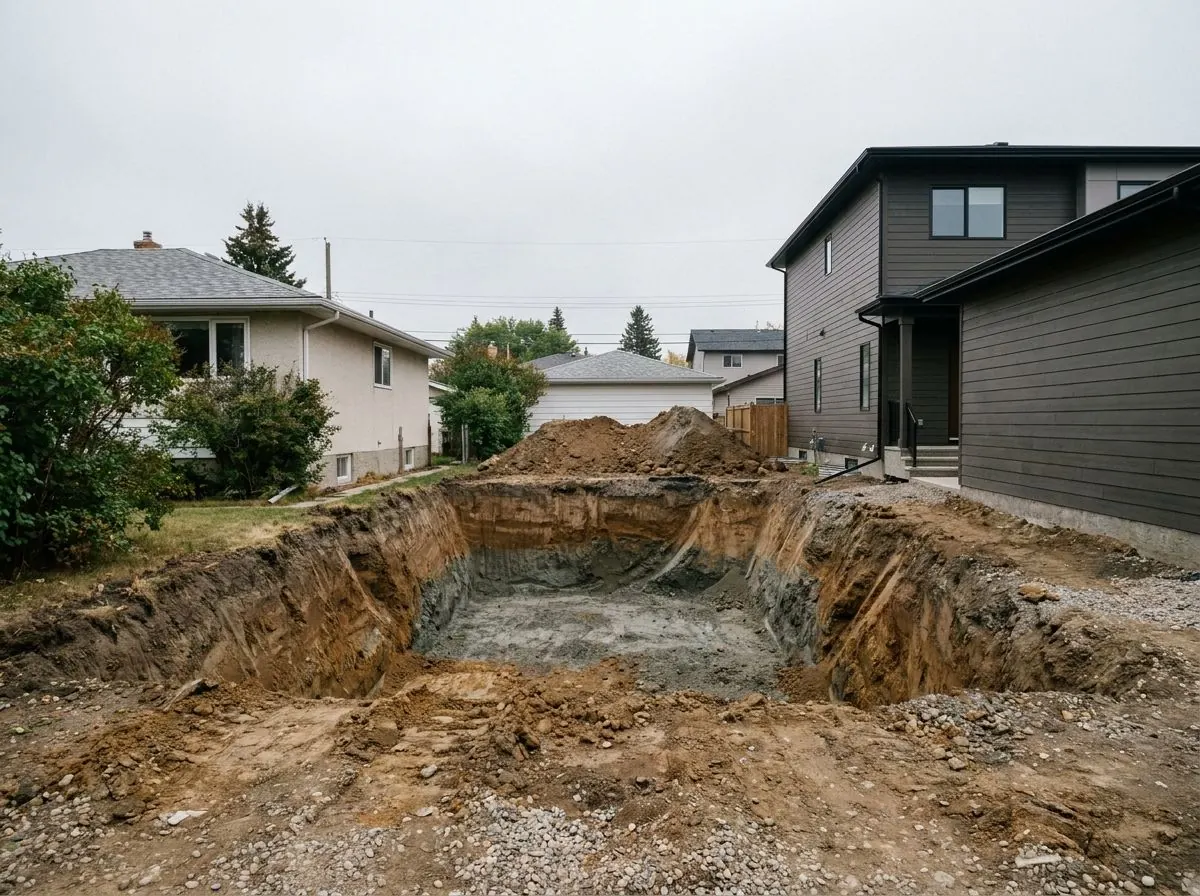
Inner-city infill lots in Calgary are commonly narrow, and a new house designed to use more of the lot than the older home did, or a zero-lot-line design built right up to one side property line, leaves a basement excavation running close to the lot lines, sometimes within arm's reach of a neighbour's foundation, fence or detached garage. A full-size excavator cannot work there without its counterweight swinging over the property line, and a machine big enough to dig fast is often too wide to get down the laneway at all. The practical result is that the job is controlled by the space around it, not by how much soil there is to move.
Digging beside a neighbour's house is the real risk. Soil under and beside an existing footing is what holds that footing up, and cutting away the ground next to it can let the neighbouring wall settle, crack or lean. Alberta's OHS Code treats this seriously: where a foundation may be affected, it must be supported by a temporary protective structure designed by a professional engineer before digging starts. Skipping that step, or discovering the neighbour's footing is shallower than assumed after the wall is already open, turns a routine dig into a structural problem, an insurance claim and a very bad relationship on a street where you plan to live.
The lot itself hides surprises. Older inner-city properties carry decades of services: a water line and sewer lateral from the house to the lane or street, sometimes abandoned lines beside the live ones, and power or gas run to a garage. Utility locates cover the utility's own plant, but not privately owned lines past the property-line valve or a homeowner's buried garage feed. Add a laneway with no room to stage trucks, a single street parking lane and neighbours who need their driveways, and a basement dig that would take a morning on a suburban lot becomes a logistics exercise that fails if it is not planned first.
How It Works
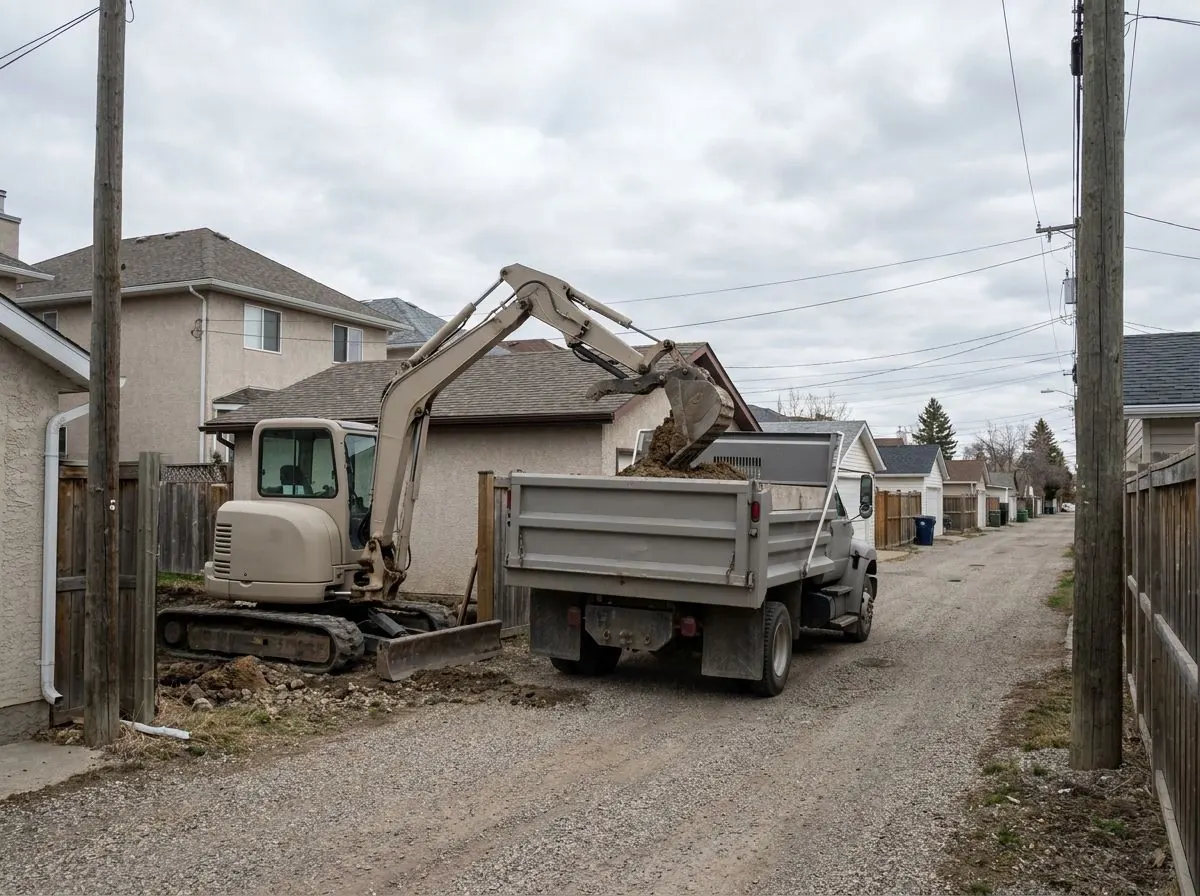
We size the machine to the lot rather than the lot to the machine. Zero-tail-swing mini and midi excavators keep the counterweight inside the track width as the upper structure turns, so the machine can dig tight to a fence or a shored wall without swinging over the neighbour's yard. A compact track loader handles material on the lot and the laneway without tearing up the surface. Where the machine cannot reach, the edge along the property line is trimmed by hand. The goal is a hole that stops exactly where the drawings say it stops, with nothing disturbed on the far side of the line.
Neighbouring foundations are dealt with before digging, not during. Working from the engineer's shoring design, we excavate in the sequence it requires, which may mean digging to a bench, pausing while the shoring trade installs its system, then continuing down. We photograph neighbouring walls, fences and garages before starting, and keep spoil and machines off their side. Soil is loaded directly into trucks as it comes out, because an infill lot has almost no room to stockpile, and whatever backfill is kept is placed where it neither loads a shored wall nor sits within 1 m of the edge.
Old services are found and dealt with deliberately. The locate request covers utility-owned lines, a private locator is brought in for the lines the utility does not mark, and anything inside the hand-expose zone is exposed without mechanical digging first. Trucking is planned around the laneway: the truck size that can actually turn in, the loading position that keeps the lane passable, and a schedule that avoids blocking neighbours at the times they need to get out. The result is a finished infill basement excavation with the neighbours' property intact and the lane open.
How the Job Runs, Step by Step
Access, neighbour and laneway survey
We measure the laneway and street access, overhead clearances, gates and turning room, and decide the machine class and truck size that genuinely fit. Neighbouring foundations, fences, garages, trees and power poles near the lot line are noted and photographed. Where the dig runs close to a neighbour's foundation, we confirm the engineer's temporary support design exists before the dig is scheduled.
Locate the old services, public and private
The locate request goes in for utility-owned lines, and a private locator marks privately owned water, sewer and garage power the utility will not mark. We confirm that the water service has been disconnected at the main by an indemnified contractor and that gas and power are cut off. Any live or abandoned line inside the hand-expose zone is exposed by hand or hydrovac before a bucket goes near it.
Open the dig in the engineer's sequence
The excavation starts away from the neighbouring foundations and works toward them in the order the shoring design requires. Where the design calls for it, we stop at a set depth so shoring can be installed before digging continues. Along property lines, the machine works with its zero-tail-swing house turned inside the lot, and the final edge is trimmed by hand where a bucket would risk the line.
Load-and-go trucking down the lane
Soil is loaded directly into trucks as it is dug, with the truck staged in the laneway or on the street in a position that keeps access open. Loads are timed so trucks are not queuing along a residential street. The lane is scraped and swept as we go so clay is not tracked out onto neighbours' driveways or the public road, and backfill is kept only where it will not load a shored wall.
Final trim, edge check and handover
The bottom is trimmed to the design elevation on undisturbed soil, and the edges along both property lines are checked against the survey. Neighbouring walls, fences and the laneway are inspected again and compared with the pre-dig photographs. The shoring, open edges and access points are left marked and protected so the forming crew arrives to a safe, finished hole on a lot that is still workable.
Equipment on This Job
Zero-tail-swing mini excavator, roughly 1 to 6 t
The machine for the tightest lots and laneways. Its counterweight stays within the track width as it turns, so it can dig beside a fence, a shored wall or a neighbour's garage without swinging over the line. It also reaches the narrow side-yard strips and utility trenches that larger machines cannot get to.
Zero-tail-swing midi excavator, roughly 6 to 10 t
Used where the lane and lot allow a little more room. It digs a full-depth infill basement faster than a mini and loads a tandem truck directly, while still turning inside its own footprint. Where both fit, the midi typically does the bulk excavation and the mini handles the edges.
Compact track loader
Moves material around a lot with no room to spare, feeds loose soil back to the excavator for loading, and keeps the laneway scraped clean. Its tracks carry it over soft ground with low ground pressure, which matters when the only route in crosses a lane or a neighbour's shared access.
Tandem dump trucks sized to the lane
Tandems turn into laneways and residential streets where tri-axles often cannot. They are loaded straight from the excavator so no stockpile builds up on the lot. Where the route allows larger trucks, we use them, but the truck is chosen by the corner it has to turn, not by the volume.
What Decides the Specification
The distance and depth of the neighbouring foundations drive most of the specification. A neighbour's footing that sits well back from the lot line and deeper than the new excavation may need little more than careful digging; one that is close and shallower than the new basement falls squarely under the OHS requirement for an engineer-designed temporary support. The engineer's design then decides the dig sequence, where benches are left, and when excavation must stop for shoring. The soil matters too: clay that stands for a day can ravel after rain, and mixed soils must be treated as the least stable material in them.
Access is the second driver. Laneway width, overhead wires, power poles, fences and parked cars decide whether a mini or midi machine fits and which truck can turn in. The more restricted the access, the smaller the machine and truck, and the more loads it takes to move the same basement. Ground conditions change the plan again: groundwater seeping into an open excavation slows the dig, softens the lane and can require pumping, and river-valley groundwater is well documented in Calgary, where a University of Calgary study found groundwater caused much of the 2013 basement flooding in Elbow Park, Rideau and Roxboro. We price and schedule around the access we can actually use, not the access that would be convenient.
Code, Safety and Permit Notes
The Alberta OHS Code sets the rules that shape infill digging. Before beginning an excavation, any foundation that may be affected must be supported by a temporary protective structure designed, constructed and installed to a professional engineer's specifications. Walls of an excavation deeper than 1.5 m must be cut back, shored or both where workers are closer to the wall than its depth, and on an infill lot there is rarely room to cut back. Protective structures deeper than 3 m must be engineer-designed. Spoil must sit at least 1 m from the edge, and the support of any nearby power pole must be maintained.
The old house comes down first, under its own City of Calgary demolition permit, and that permit process is what gets the services disconnected: the water service is cut off at the main by an indemnified contractor. On the infill dig itself, new water, sanitary and storm connections in the City right-of-way must be installed by a utility indemnified contractor, and breaking or digging into a City road right-of-way needs a City excavation permit. A Tree Protection Plan is part of the demolition permit where work comes within 6 m of a public tree. Utility locates never cover private lines, and no mechanical digging happens within 1 m of any locate mark until the line has been exposed.
General guidance only. The municipality, Alberta’s safety codes and the engineer of record, where there is one, decide what applies to your job.
Around Calgary
Southwest Calgary holds the city's largest belt of communities the City classes as inner city, and Altadore is one of them. An infill dig in an established community like it can mean a narrow lot between occupied homes, a laneway as the most practical machine access, and a new basement that reaches closer to the lot lines than the one it replaces. In the northeast, Bridgeland/Riverside brings the same kind of inner-city digging to a different setting: it fronts the Bow River, and parts of the community lie in the City's mapped 2013 flood extent, so where the lot sits relative to the Regulatory Flood Map is worth checking before the dig is planned.
In the northwest, West Hillhurst is another inner-city community along the Bow. On older lots anywhere in these communities, the services under the yard are the unknown. The City says most water services, including in pre-1950 homes, are copper, but lead connections were used for a short period, primarily between 1939 and 1947, and galvanized steel services also exist. That is why we treat every old line on an infill lot as unknown until it is located, exposed and confirmed disconnected, and why owners should contact the City about their water service before the old house comes down.
Often Done Alongside
Residential Building & Garage Demolition
House and garage teardown, foundation removal and a level lot for the next build.
Deep Basement Excavation
Full and walkout basement digs for new custom homes on open lots and acreages.
Deep Utility Trenching (Water, Sewer & Storm)
Shored, bedded trenches for water, sanitary and storm service lines.
Where We Do This Work
Calgary, quadrant by quadrant
Acreage country
Neighbouring cities and towns
Infill & Tight-Access Digging: Questions We Get
Can an excavator actually fit down my laneway?
Do I need shoring if my infill basement is close to the neighbour's house?
Do you offer skid steer and mini excavator work on small inner-city lots?
What happens to the old water and sewer lines on an infill lot?
Can excavation be done in a Calgary winter?
Get a Written Estimate for Infill & Tight-Access Digging
Send the basics and we will come back with questions or a time to look at the site. Drawings, a geotechnical report or photos of the access all help.
Considering Infill & Tight-Access Digging?
Call Aspen Excavating or send the details. We will look at the site, tell you whether infill & tight-access digging is the right scope, and price it in writing.