Land Clearing & Vegetation Removal in Calgary
We clear building sites, driveway corridors and overgrown acreage land down to clean mineral soil: brush and trees taken down, stumps and root masses grubbed out, boulders lifted, and the debris mulched or hauled. Trees you want to keep stay fenced and untouched.
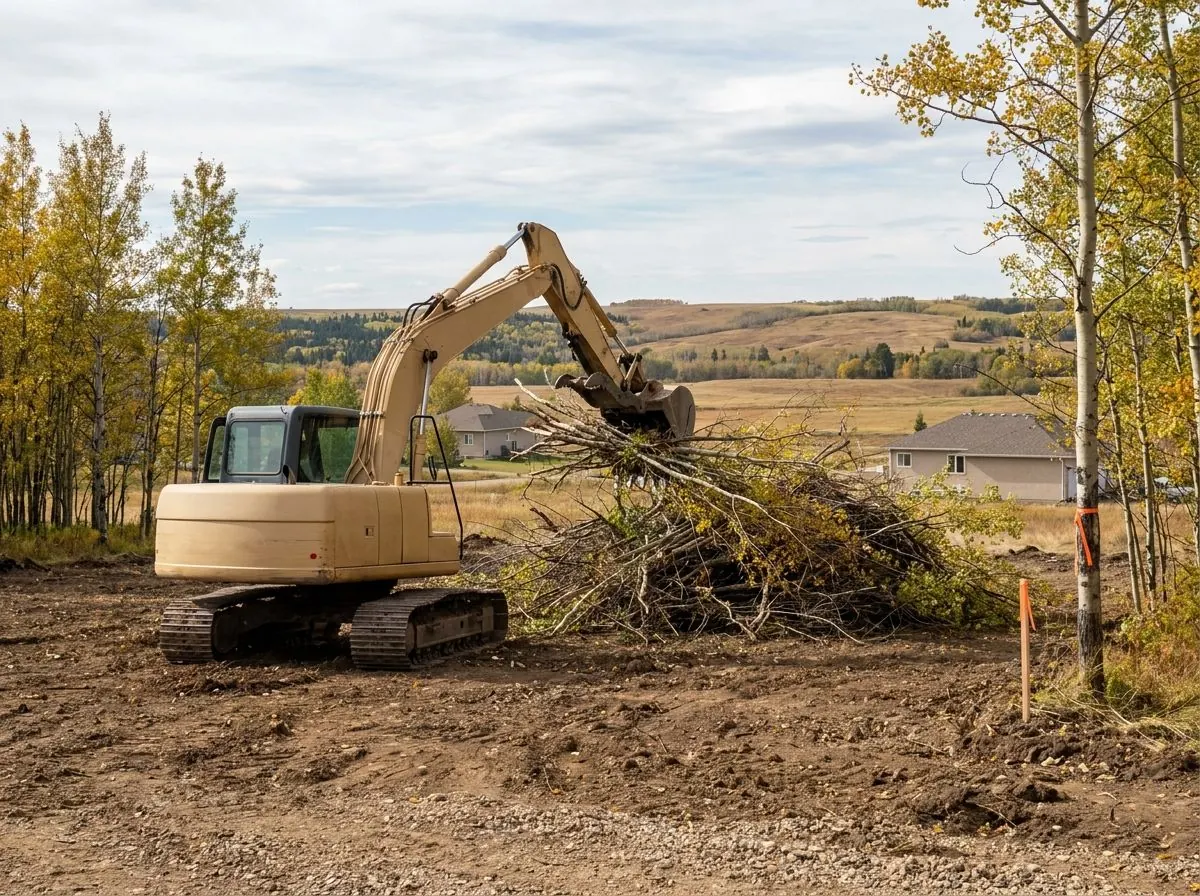
The Problem It Solves
Brush and trees are the easy part. What causes trouble on a building site is what sits below them: stumps with root plates spreading well past the trunk, fibrous root mats running through the upper soil, buried boulders, and pockets of rotting organic material. Leave any of that in the ground under a driveway, a garage pad or a house foundation, and it decays, collapses and settles. The result shows up a season or two later as a dip in the driveway, a cracked slab or a low spot that holds water, long after the clearing crew has gone.
Rough clearing also damages what the owner wanted to keep. Machines tracking over the root zone of a mature spruce or aspen compact the soil it depends on, and a few loads of spoil piled against its trunk can kill it slowly. A careless swing tears bark and snaps limbs. On acreage land, where a stand of trees can be a large part of why someone chose the parcel, losing the windbreak or the privacy screen through carelessness is a loss no replanting budget replaces quickly.
Finally, cleared ground is bare ground. Strip the vegetation from a slope, a coulee edge or a lot that drains toward a ditch, and the next heavy rain or the spring melt carries soil away. Sediment ends up in ditches, culverts, neighbouring yards and waterways, and gullies start cutting into the very area the owner intends to build on. Clearing that ignores what happens to the land afterward simply trades one problem for another.
How It Works
We clear to the depth the next stage of work needs. Where a house, garage, shop or driveway is going, we don’t stop at cutting trees off at ground level: stumps are pulled with an excavator, root masses are shaken out and removed, and the grubbed area is taken down to clean mineral soil so the grading crew is building on material that won’t rot. Boulders are lifted out and either set aside for landscaping or hauled. Where the land is only being opened up, such as a trail, a fence line or a view corridor, lighter clearing and mulching may be all it needs.
We decide what happens to the debris before we start cutting. Mulching with a mulching head on a compact track loader turns brush and small trees into a chip layer that stays on site and helps hold the soil, which suits open acreage areas that are not being built on. Stumps, root balls and larger wood are usually hauled, because they cannot go under structures or into structural fill. Burning is only an option where the local municipality’s rules and any permit in force at the time allow it, and in most cases mulching or hauling is simpler.
Trees staying on the property are protected first. We agree with you which trees stay, fence their root zones before any machine arrives, and keep stockpiles, parked equipment and grade changes outside that fence. Then we sequence clearing so bare ground is exposed for as short a time as possible and stabilized quickly afterwards, with the slope left rough rather than smoothed, sediment controls at the downslope edge where needed, and grading or seeding following on without a long gap.
How the Job Runs, Step by Step
Walk the site and mark what stays
We walk the property with you and mark the clearing limits, the trees to keep and any wet areas, slopes or drainage paths that need care. Protection fencing goes around retained trees before any machine work. We also agree where debris will be mulched, piled for loading or kept for landscaping.
Locate buried lines, public and private
Utility locates are requested before any grubbing, because pulling a stump disturbs ground well below the surface. Acreage septic fields, water wells and power run to a shop are privately owned and are not marked by the utility, so the owner or a private locator shows us where they are. Within 1 m of either side of a locate mark (5 m for a high-pressure pipeline), the line is exposed by hand or a non-destructive method before a machine digs there.
Cut brush and fell trees
Brush and small trees are mulched in place or cut and piled, and larger trees are felled away from retained trees, buildings and fences. Trunks and heavy limbs are bucked into manageable lengths for loading. Nothing is dragged through the fenced root zones of trees you are keeping.
Grub stumps, roots and boulders
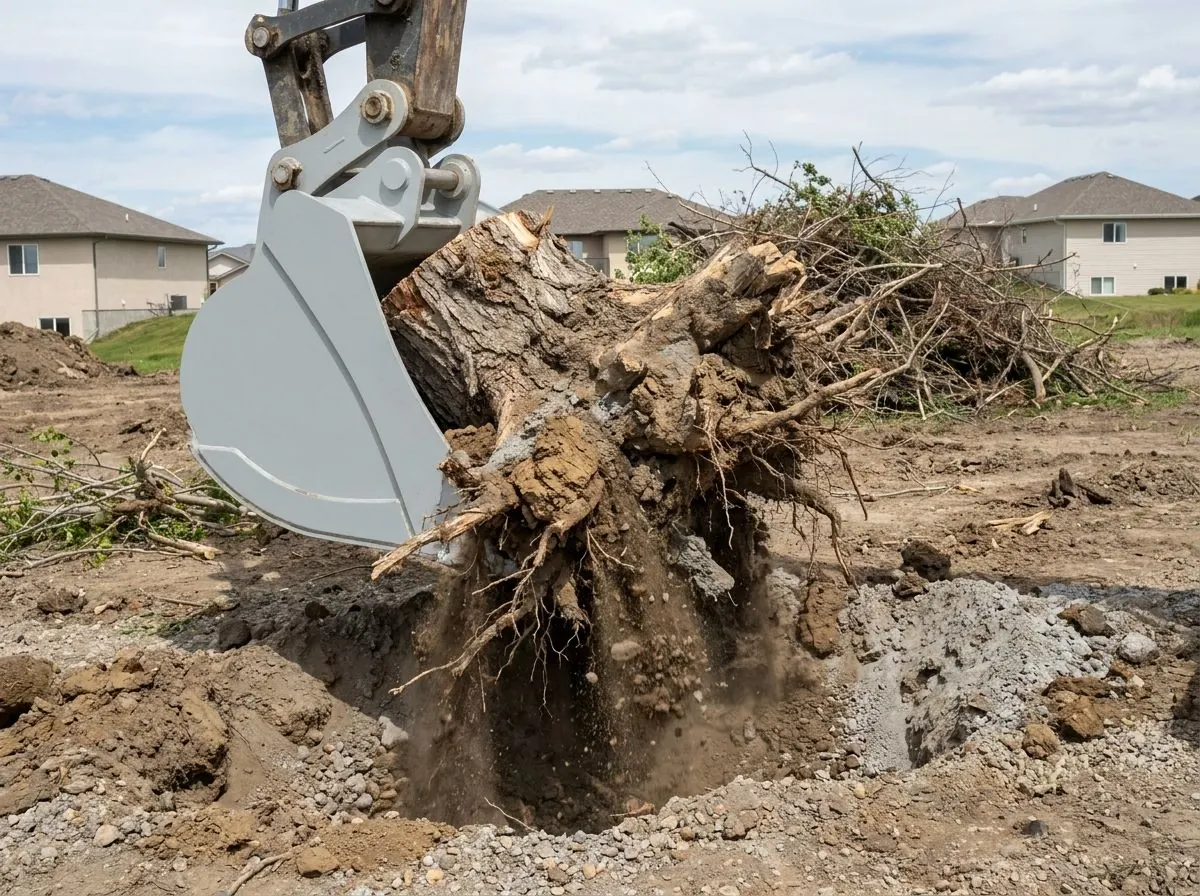
An excavator pulls each stump, shakes the soil from the root mass and lifts it out, then rakes through the area to recover broken roots. Buried boulders are dug out and set aside or loaded. The holes left behind are filled and compacted as part of the grading that follows, not left to settle under a future slab.
Haul, mulch and stabilize the ground
Stumps, root balls and wood are loaded and hauled, or brush is mulched and spread where the ground is not being built on. Cleared slopes are left roughened, and sediment controls go in at the downslope edge where runoff could leave the site. The area is then ready for stripping and grading or for seeding.
Equipment on This Job
Midi excavator with hydraulic thumb
A midi excavator, roughly 6–10 t, does most stump pulling and root grubbing on residential lots and acreages. The thumb grips stumps and root masses so they can be shaken clean of soil and placed precisely in a pile or truck, and the machine is light enough to work near fences and trees being kept.
Full-size excavator
A full-size excavator, roughly above 10 t, handles mature stumps with wide root plates, buried boulders and heavy loading. Its reach lets it work from outside a protected root zone and lift material over it, rather than tracking through the ground a retained tree depends on.
Compact track loader with mulching head
A compact track loader fitted with a mulching head grinds brush and small trees into chips where they stand. Its low ground pressure suits soft acreage ground, and the chip layer it leaves helps protect cleared soil from rain and runoff on areas that are not being built on.
Tri-axle and tandem dump trucks
Trucks haul stumps, root balls, logs and boulders off site when they cannot be mulched or reused. Tri-axles carry more per trip on open acreage access; tandems fit tighter driveways and residential lots. Stump debris is kept out of soil loads, because clean fill means natural, unprocessed soil.
What Decides the Specification
The end use sets the clearing standard. A pasture, a trail or a view corridor can be cleared by cutting and mulching at ground level, leaving the root systems to hold the soil. A building site, a driveway corridor or anything that will carry fill, gravel or concrete needs full grubbing: every stump and root mass out, organic pockets removed and the grubbed area taken down to mineral soil, because organic material in the ground decays and settles. The size and species of the trees matter too. Large stumps commonly have wide root plates that disturb a lot of ground when they come out, which in turn affects how much fill and compaction the grading stage needs.
Debris handling depends on volume, access and where the material can legally go. Mulch suits brush and small stems on ground that will stay vegetated. Stumps with soil still clinging to them are not clean fill, since the City of Calgary defines clean fill as natural, unprocessed soil, so they travel as wood waste to a facility that accepts them. Boulders can often be reused in landscaping. Slope, soil type and how close the cleared ground sits to a ditch, wetland or watercourse decide how much erosion protection is needed after the machines leave, and whether clearing should be staged rather than done all at once.
Code, Safety and Permit Notes
Pulling a stump is ground disturbance, so buried utilities are located before grubbing starts. Under the Alberta OHS Code, the hand-expose zone is 1 m on each side of a locate mark, and 5 m for a high-pressure pipeline; inside that zone, roots are cleared by hand or by a non-destructive method the owner accepts before any machine digs. On rural land, the Pipeline Rules set a controlled area 30 m on each side of a pipeline’s centreline, and work there needs notice to Utility Safety Partners. Private septic fields, wells and owner-run power lines are not located by the utility and must be identified by the owner or a private locator.
Which approvals apply depends on what else the clearing job involves. In Calgary, stripping and grading under 1,000 m² does not need a development permit, and erosion and sediment control follows the City’s Code of Practice by site size: Good Housekeeping under 0.4 ha, a Notice to Proceed from 0.4 to 2.0 ha, and Plan Approval above that. Rocky View County uses similar size tiers. Public trees are protected in their own right; the City’s demolition permit process, for example, asks for a Tree Protection Plan where work comes within 6 m of a public tree. Burning and nesting-season timing are governed separately, so we confirm those with the relevant authority or your environmental adviser rather than guess.
General guidance only. The municipality, Alberta’s safety codes and the engineer of record, where there is one, decide what applies to your job.
Around Calgary
Bearspaw shows why clearing on acreage land needs a plan. The Bearspaw Area Structure Plan describes a landscape of slopes, coulees, wetlands and riparian areas, draining to three catchments: Big Hill Springs Creek, Nose Creek and the Bow River. Clear a building envelope or a driveway corridor on ground like that without thinking about where the water goes, and runoff carries soil down the coulee toward the creek. On these two-acre-style parcels we keep clearing to the building and access footprint, leave the tree cover that holds the slopes, and stabilize exposed ground quickly.
Further west in Rocky View County, the County’s own development plan describes the West Agricultural Area as foothills, wetlands, woods, deep ravines and coulees, with servicing primarily through private on-site wells and septic systems. That combination shapes clearing on rural parcels: treed ravines and coulee edges where exposed soil can wash away, wet low areas that are better left alone, and private wells and septic fields that no utility locator will mark. We clear around those features deliberately, and we plan debris haul-off with long rural access roads in mind.
Often Done Alongside
Mass Earthworks & Site Grading
Cut and fill, topsoil stripping and laser or GNSS grading to design elevations.
Driveway & Access Road Rough-In
Acreage driveways and access roads built on geotextile and crushed gravel.
Site Clean-Up & Material Haul-Off
Dirt, clay, rock and debris sorted, hauled off and the site left clean.
Where We Do This Work
Calgary, quadrant by quadrant
Acreage country
Neighbouring cities and towns
Land Clearing: Questions We Get
Is it better to mulch cleared brush or haul it away?
Can I burn the brush piles after land clearing?
When is the right time of year to clear trees?
How do you keep the trees I want to save alive?
Can excavation be done in a Calgary winter?
Get a Written Estimate for Land Clearing
Send the basics and we will come back with questions or a time to look at the site. Drawings, a geotechnical report or photos of the access all help.
Considering Land Clearing?
Call Aspen Excavating or send the details. We will look at the site, tell you whether land clearing is the right scope, and price it in writing.