Culvert Installation & Ditch Re-Grading Around Calgary
A driveway culvert that is undersized, crushed or set at the wrong grade turns every spring melt into a washout. We install approach culverts and re-grade roadside and yard ditches for acreages around Calgary, with the pipe bedded on the ditch flowline, covered in compacted lifts and armoured at the ends.
The Problem It Solves
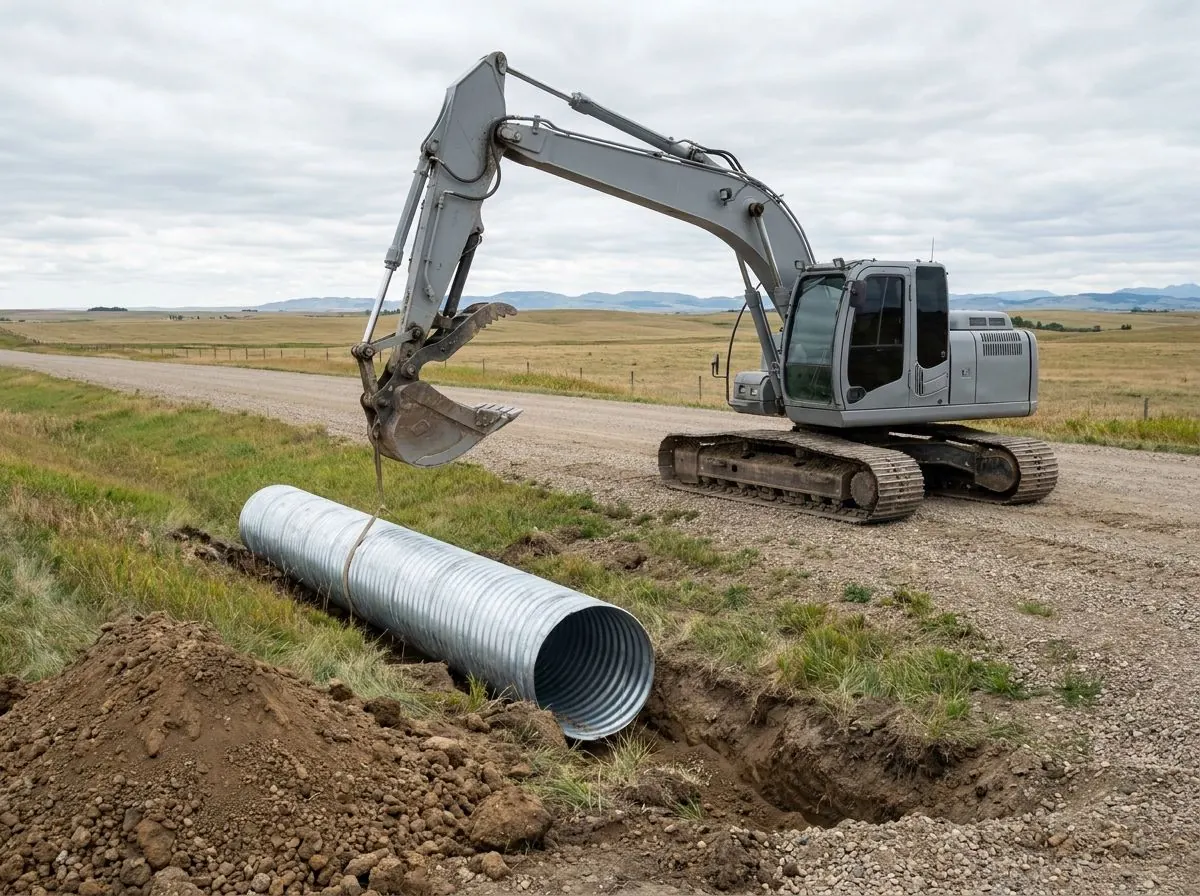
Many acreage driveways cross a roadside ditch, and the culvert under that crossing does more work than anything else on the approach. When it fails, the signs are obvious in March and April: water ponding on the upstream side, meltwater running across the driveway instead of under it, gravel washed into the ditch, a soft rut where the approach used to be firm. The causes are usually just as plain. The pipe is too small, it was crushed at the ends by a loader or a snowplough, it rusted through along the bottom, it sags in the middle, or it was set higher than the ditch so water has to back up before it can get in.
Ditches fail more slowly. Silt, cattails, grass and years of grader spoil fill the bottom until the flowline disappears, and water that once moved down the ditch now sits against the road shoulder and the approach. Standing water softens the subgrade under the driveway, freezes into it and heaves it, and in spring it goes wherever the ground is lowest, which may be your garage, a septic field or the neighbouring acreage. A ditch that was flattened during a driveway build or a landscaping job can hold water for weeks after the snow has gone.
A culvert installed without the right approval creates its own problems. Rocky View County requires permission for any culvert installation, alteration or removal in a County right-of-way, and inspects new and upgraded approaches both before and at completion. A pipe below the County's 450 mm minimum, a crossing that was never inspected or an approach steeper than the County allows can mean digging the whole thing up again. And ice does not care how new the pipe is: a culvert set with a sag or too little fall fills with water in the fall, freezes solid and is still plugged when the melt arrives.
How It Works
We start with the approval, not the pipe. For an approach in Rocky View County that means the Road Approach Application and the County's inspection of the proposed location, so the culvert size, position and approach grade are settled before anything is ordered. Then we survey the ditch flowline well upstream and downstream of the crossing and set the culvert inverts to match it. A pipe on the true flowline, with a continuous fall and no sag, drains itself dry after each event, which is the single most useful thing a culvert can do against spring ice.
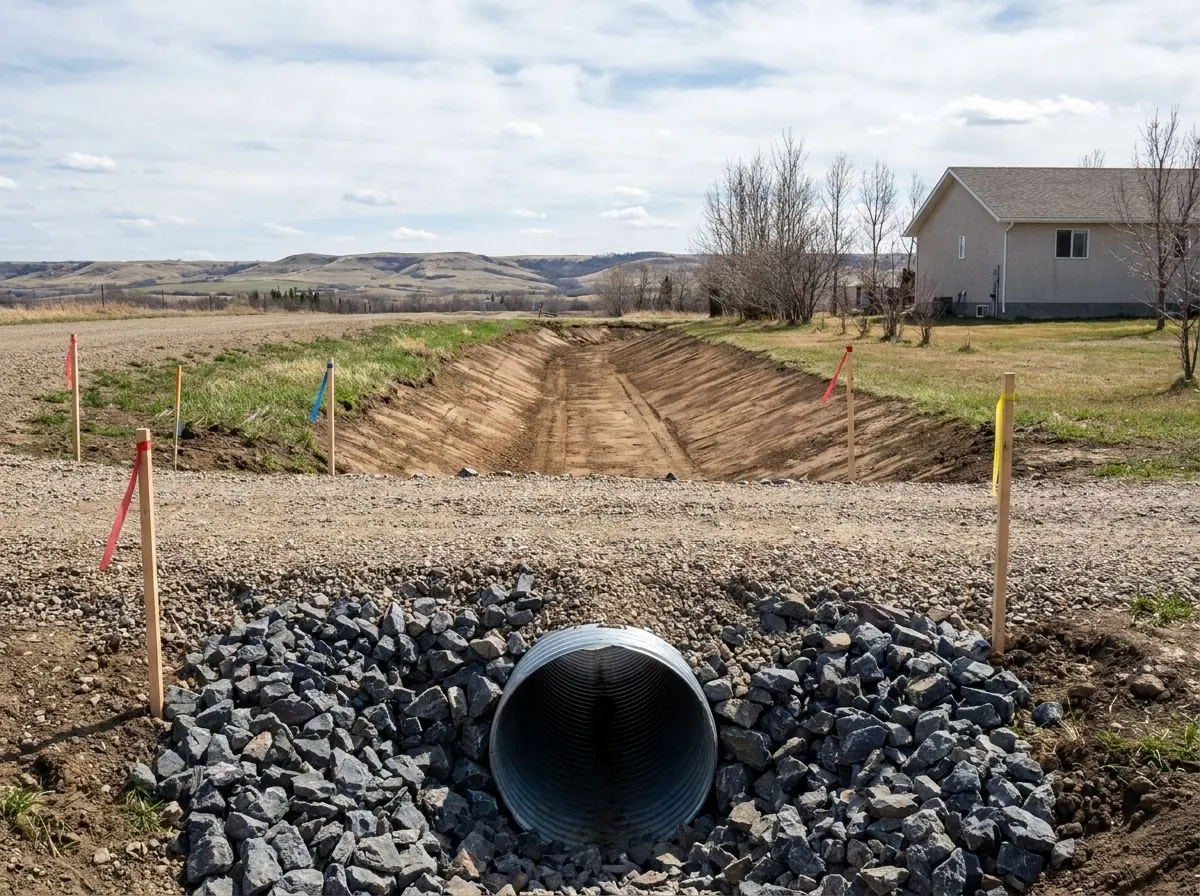
The crossing is excavated through the ditch, soft and organic soil is removed from the bottom, and a granular bed is placed, shaped and compacted so the pipe is supported along its full length. The pipe is set on grade and the haunches are filled and compacted evenly on both sides in thin lifts, because a pipe supported only underneath deflects under traffic. Cover goes on in compacted lifts to the depth the approval calls for, and the approach is built up over it. At the ends, the ditch is shaped into the pipe and angular riprap is placed over geotextile where the water will scour.
Ditch re-grading restores the flowline the culvert depends on. We clean out silt, vegetation and slumped soil, re-cut the bottom to a continuous fall using a rotating laser or GNSS machine control checked against survey, and reshape the side slopes so they stop sloughing into the channel. Spoil is either spread where the owner wants it and the grading allows, or hauled away. Bare slopes are left ready for seeding or erosion control, and the driveway itself can be finished as part of a driveway and access road rough-in.
How the Job Runs, Step by Step
Confirm the authority, the approval and what is buried
We identify who controls the ditch: Rocky View County, Foothills County, a town, the City or the owner, because each has its own approval path. Roadside rights-of-way commonly carry buried power, telecom and gas lines, so the crossing is located and anything inside the 1 m hand-expose zone is exposed by hand. Rural sites also need a check for pipelines within 30 m of the work. If a pipeline is within 5 m, it is exposed by hand before machine work continues.
Survey the flowline and set grades
We shoot ditch bottom elevations upstream and downstream to find the true flowline and set the culvert inlet and outlet inverts to it. We check the cover available between the pipe and the finished approach, and confirm the approach can be built without exceeding the County's 4% grade. Where the numbers do not work, the approval or design is revisited before digging.
Excavate the crossing and build the bed
Water in the ditch is diverted or pumped past the work. The crossing is excavated to below the pipe invert, soft or organic material is removed, and granular bedding is placed, shaped to the pipe and compacted. The bed is checked to grade along its length so the pipe cannot sag once loaded.
Set the pipe, fill the haunches and build cover
The culvert is set on line and grade, and backfill is placed and compacted evenly on both sides in thin lifts with hand-operated compactors near the pipe. Cover is built up in compacted lifts to the specified depth before loaded trucks cross it. Heavy compaction equipment stays off thin cover, the same caution the City's waterworks specification applies to buried pipe.
Armour the ends, shape the ditch and book the inspection
Ditch transitions are shaped into both ends, geotextile is laid, and riprap is placed at the outlet and wherever the inlet will scour. The ditch is re-graded to carry water away from the crossing. For a Rocky View County approach, the completed work is inspected by the County before the job is closed out.
Equipment on This Job
Full-size excavator
Above roughly 10 t, with the reach and lifting capacity to dig a crossing through a deep roadside ditch, set longer and heavier culvert pipe on its bed without dragging it, and place riprap rock by rock instead of dumping it.
Midi excavator with a tilting ditch bucket
Roughly 6 to 10 t. The wide, smooth tilting bucket cuts a clean ditch bottom and trims side slopes to a consistent angle in one pass, without tracking in the wet channel.
Rotating laser and GNSS machine control
A rotating laser sets a plane for a straight culvert grade; GNSS guides longer ditch re-grades along a design surface. Neither replaces a survey check of the inverts, which we still take before and after the pipe goes in.
Rammer and vibratory plate compactor
Compact the granular haunches beside the pipe and the first cover lifts over it, where a large roller would deform the culvert. A rammer works cohesive fill; the plate works granular bedding and cover.
What Decides the Specification
Size and length come from the approval, not from what fits in a pickup. In Rocky View County, approach culverts cannot be less than 450 mm in diameter and cross-grade culverts under County roads cannot be less than 600 mm; the actual size for a given crossing depends on the drainage area and flow it carries, set by the County or an engineer. The County's standards give 22 m as the maximum desirable culvert length, and treat culverts of 1.5 m or larger as bridge-sized, which is a different design exercise entirely. Culvert length is driven by the approach width plus the side slopes needed to carry the driveway over the pipe.
Cover, bedding and grade decide whether the culvert survives traffic and winter. The pipe needs enough compacted cover to spread wheel loads from fuel trucks, concrete trucks and snow-clearing equipment, and granular bedding so it is supported evenly instead of bridging on high spots. Calgary-area frost typically reaches around 2 m (7 ft), and the City reported 2.4 m (8 ft) in the severe winter of 2019, so an approach culvert is well inside the frozen zone. The defence is grade: a pipe that drains dry after every event has little water to freeze. Soft clay ditch bottoms can need more sub-excavation under the bed and more armour at the outlet than firm gravel ones.
Code, Safety and Permit Notes
Rocky View County requires County permission for any work within, over or through County lands, including rights-of-way, road allowances and easements, and its permit items specifically include culvert alteration, installation or removal. New and upgraded road approaches need a Road Approach Application, and the County inspects the location in advance and again at completion. The County's Servicing Standards set the 450 mm minimum for approach culverts, 600 mm for cross-grade culverts under County roads, a 22 m maximum desirable length and a 4% maximum approach grade, and note that a culvert is typically required unless the approach is at a high point. Hauling on County roads may need a Road Use Agreement or permit.
Other authorities have their own rules. Outside Rocky View County, the approval path runs through whichever municipality controls the road; in Calgary, breaking into a City road right-of-way needs an Excavation Permit under the Streets Bylaw. Culvert standards outside Rocky View County are confirmed with that municipality. Work in a natural creek or wetland, rather than a roadside ditch, can require provincial Water Act authorization, so check before digging. Culvert trenches are usually shallow, but any part a worker enters deeper than 1.5 m is sloped or supported under the OHS Code, spoil stays at least 1 m back, and the Pipeline Rules require hand exposure once work comes within 5 m of a pipeline.
General guidance only. The municipality, Alberta’s safety codes and the engineer of record, where there is one, decide what applies to your job.
Around Calgary
Springbank shows why culverts matter on acreages. The Springbank Area Structure Plan describes a community defined by the Bow River to the northeast and the Elbow River to the south, with twelve storm water catchment areas, five of them flowing north to the Bow. Many areas are comprehensively planned two-acre subdivisions on County roads, which means many individual driveways crossing roadside ditches that carry that runoff. Every one of those crossings is a County approach, subject to the County's culvert minimums and inspections, and a single undersized or high-set pipe can back water up onto the lots upstream of it.
North of the Bow, Bearspaw's plan describes three drainage catchments, draining to Big Hill Springs Creek, Nose Creek and the Bow River, and refers to slopes, coulees, wetlands and riparian areas. On rolling acreage ground like that, runoff concentrates in low crossings, and a culvert at the bottom of a driveway dip takes far more water in spring than one on flat ground. South of Calgary, acreages around De Winton sit in Foothills County, which runs its own approvals, so the same excavation and bedding practice applies but the paperwork starts with Foothills County rather than Rocky View.
Often Done Alongside
Driveway & Access Road Rough-In
Acreage driveways and access roads built on geotextile and crushed gravel.
Slope Stabilization & Erosion Control
Runoff diversion, benching, riprap, silt fence and revegetation on slopes and banks.
Pond, Dugout & Retention Basin Digging
Acreage dugouts, ponds and engineered stormwater basins, dug from test holes up.
Where We Do This Work
Calgary, quadrant by quadrant
Acreage country
Neighbouring cities and towns
Culverts & Ditches: Questions We Get
What size culvert does my acreage driveway need?
Do I need County permission to replace an existing driveway culvert?
Why does my culvert freeze solid every spring, and will a new one fix it?
Can you re-grade the ditch in front of my acreage?
Who handles utility locates and permits?
Get a Written Estimate for Culverts & Ditches
Send the basics and we will come back with questions or a time to look at the site. Drawings, a geotechnical report or photos of the access all help.
Considering Culverts & Ditches?
Call Aspen Excavating or send the details. We will look at the site, tell you whether culverts & ditches is the right scope, and price it in writing.