Concrete Slab & Asphalt Breakout in Calgary
We break out and remove Calgary driveways, garage slabs, patios, basement floors and parking lots. Edges you keep are saw-cut first, embedded lines are located before the breaker touches the slab, rebar is pulled for scrap, and concrete and asphalt leave in separate loads for recycling.
The Problem It Solves
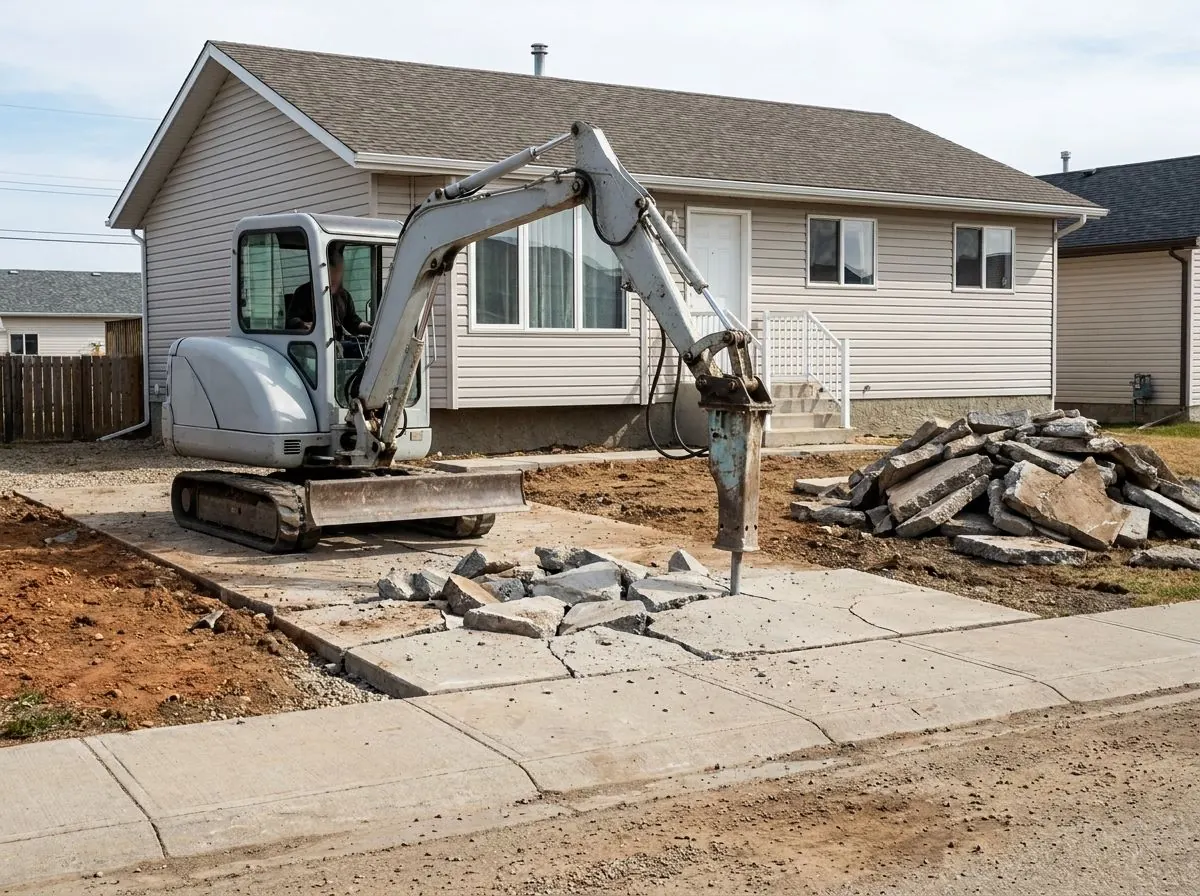
A cracked driveway, a heaved garage slab or a tired parking lot looks like simple demolition until someone tries to take out only part of it. Swing a bucket or a breaker at a slab without a saw cut and the fracture runs wherever the concrete is weakest: under the sidewalk you meant to keep, into the garage apron, or through the edge of the neighbour's pad on a shared driveway. Replacing the damage you did not intend to cause is often more work than the removal itself.
Concrete also hides things. Garage slabs and patios can carry power conduit to a detached garage, a buried line to a hot tub or a shed, or heating tubing, and none of those privately installed lines is marked by a utility locator. Break into a live conduit with a hydraulic breaker and you have a safety incident, not a delay. Reinforcing steel is a second hidden cost: rebar and mesh tangle into the rubble, jam loading, and can turn a clean concrete load into one a recycler may handle differently or refuse.
Then there is where it all goes. A truck loaded with asphalt, concrete, gravel base and topsoil in one pile is a load nobody wants. City of Calgary landfills state that they do not recycle road asphalt, brick or concrete, and loads mixed with those materials are charged the Disposal Surcharge Rate. Leave the site with a patio gone from beside the house and a low spot where it used to be, and the next rainstorm runs straight toward the foundation.
How It Works
We start with the line between what goes and what stays. Every edge you are keeping is saw-cut through the full depth before any breaking, so when the breaker fractures the slab the crack stops at the cut and the retained concrete keeps a straight, square face for the new pour to meet. Where a slab is tied into a foundation wall, a garage grade beam or a sidewalk you want to keep, we mark the tie-in and break back to it in small, controlled bites instead of letting a large machine pull at it.
The breaker size is matched to the slab. A thin patio or sidewalk comes apart with a skid-steer or compact track loader breaker that fits through a gate. A thick, reinforced garage slab, loading apron or foundation pad needs a breaker on a midi or full-size excavator, working from the outside edge in so pieces can drop away. We cut rebar and wire mesh as the concrete lets go and stack the steel separately. Water on the work face keeps the dust down for the neighbours and the crew. Breaking is the loudest part of any removal, so we plan it for normal working hours, let the owner know when the breaker will run so neighbours can be told, and switch to the bucket or ripper as soon as the pieces are small enough, which shortens how long the noise lasts.
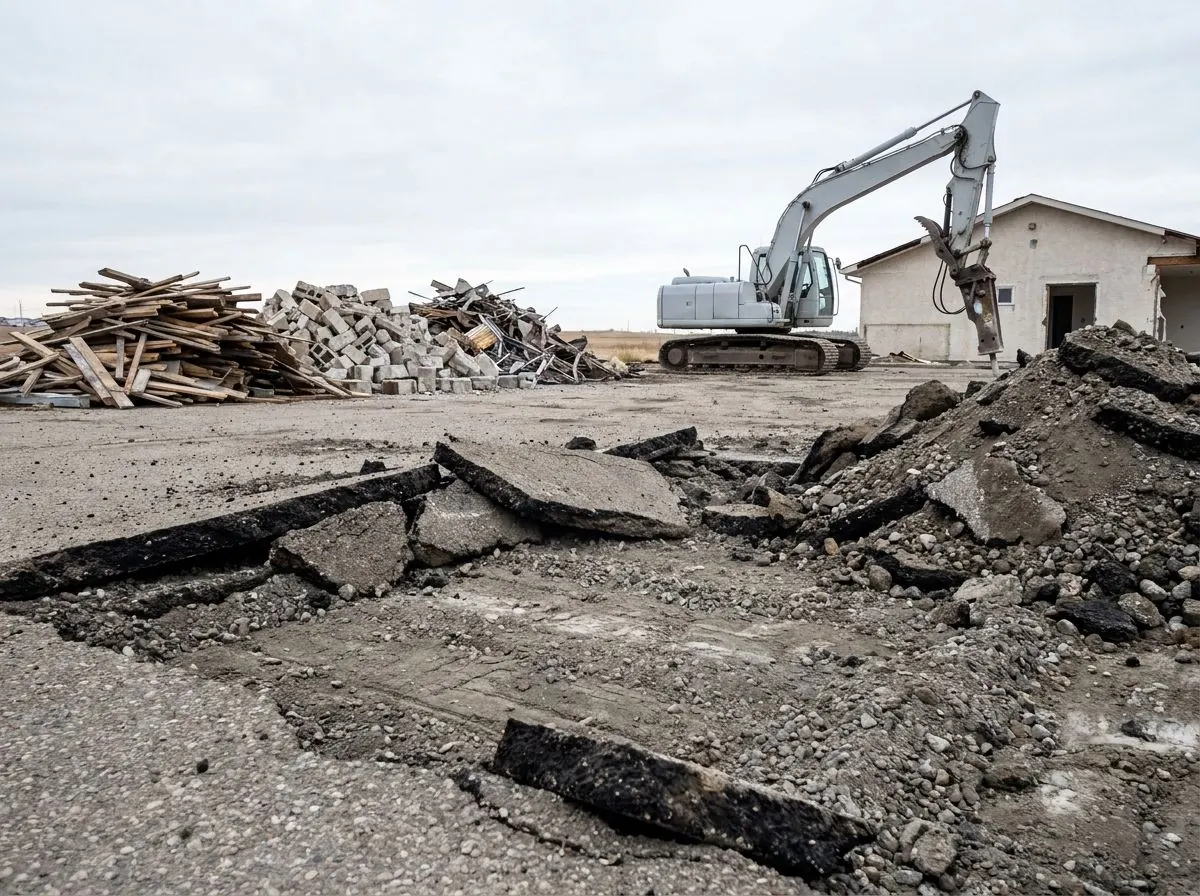
Material is sorted as it comes up. Asphalt goes in one set of loads, clean concrete in another, steel to scrap, and the gravel base is either left in place for the new surface or loaded separately if the subgrade needs work. Concrete and asphalt go to recycling facilities, not to a City landfill as mixed waste. Once the surface is off, we clean the subgrade, look at what is underneath, and rough-grade so water moves away from the house. You get a clean base, ready for the concrete or paving crew.
How the Job Runs, Step by Step
Scope the slab and what is inside it
We walk the area, mark every edge to keep, and ask what the slab has carried: garage power, a hot tub feed, a gas line to a barbecue or heating tubing. Locates are requested at least 3 full working days ahead, with more time allowed in busy season, and private lines the utilities do not mark are traced by a private locator. Where the removal breaks into the City road right-of-way at the curb or sidewalk, an Excavation Permit is applied for before the date is booked. A test break at a corner shows the thickness and whether there is rebar, mesh or neither.
Saw-cut the keep lines
Each retained edge is cut full depth with a concrete saw fed with water to hold down dust. On asphalt, the cut gives the paving crew a clean vertical joint to tie into, instead of a ragged edge that unravels. Cuts are set back from foundation walls and grade beams where the drawings or the owner want those left untouched. Nothing is broken until every keep line is cut.
Break from the open edge inward
The breaker works from the open edge back toward the saw cuts, so each piece has somewhere to move and the force does not travel into what stays. On reinforced slabs, the rebar and mesh are cut as the concrete releases and pulled clear of the pile. Inside a garage or basement, we use a machine that fits the door and protect walls, posts and the foundation with the breaking pattern. Plywood or mats cover driveways and walks the trucks will cross.
Sort, load and haul
Concrete, asphalt, steel and any contaminated or oily material are kept in separate piles and loaded into separate trucks. Clean concrete and asphalt go to a recycler that accepts them, never to a City landfill; steel goes to scrap metal. If a slab turns out to be stained with fuel or oil, that material is set aside and the owner is told before it moves, because it is no longer a simple recycling load. Street and laneway are swept at the end of each loading day.
Clean the subgrade and set the grade
With the surface gone, we remove loose rubble, pockets of old sand and any debris from the base so the next crew sees true subgrade. Soft spots are pointed out for the paving or concrete contractor to decide on, rather than covered over. Where a patio or walkway came out beside the house, the ground is rough-graded to fall away from the foundation. The site is left clean, level and ready to form, pave or landscape.
Equipment on This Job
Excavator-mounted hydraulic breaker
On a midi or full-size excavator, the breaker delivers enough impact to fracture thick garage slabs, loading aprons and old foundation pads without the machine driving onto the concrete it is breaking. The boom reach lets it work from the edge inward while the operator stays well back from flying chips.
Skid-steer or track-loader breaker
For patios, walks and backyard slabs behind a narrow gate, a breaker on a compact loader gets in without tearing up lawns. The same loader then switches to a bucket to clear broken pieces to the truck, which cuts the number of machines on a small residential lot.
Water-fed concrete saw
A diamond-blade saw cuts the keep lines full depth through concrete or asphalt so the fracture stops where you want it. The water feed controls dust at the cut and cools the blade, and the result is a square joint the new pour or paving can meet.
Excavator with thumb and ripper
Asphalt usually peels up in sheets with a ripper tooth or the bucket edge rather than needing a breaker. The thumb pulls rebar and mesh out of the rubble, sorts concrete from asphalt, and loads each material cleanly into its own truck.
What Decides the Specification
Thickness and reinforcement decide the method more than area does. A thin sidewalk or patio with no steel breaks quickly under a compact breaker. A garage slab, apron or commercial pad with rebar takes a larger breaker, time to cut the steel loose and more careful sorting. Wire mesh tangles in a way rebar does not, so meshed slabs are broken into smaller pieces. What sits underneath also matters: a slab on a thick gravel base may leave a reusable base behind, while a slab poured straight on clay usually leaves soft, uneven ground the next contractor will want cleaned out.
What stays behind drives the rest. A full tear-out with no neighbours close is open breaking and fast loading. A partial removal with foundation walls, a shared driveway or a retained sidewalk means saw cuts, a smaller breaker near the keep lines and slower work at the edges. Basement floor slabs are their own case: the machine has to fit the access, the broken concrete has to come out through a window well or a door, and the foundation walls must not be disturbed. The digging that follows a basement slab removal belongs on our underpinning and basement lowering page.
Code, Safety and Permit Notes
Alberta's OHS Code requires the employer to have buried or concrete-embedded facilities identified and their locations marked before ground disturbance begins, which is why we locate before breaking a slab, not just before digging under one. Inside the hand-expose zone, 1 m each side of the locate marks, a line has to be exposed by hand or by a non-destructive method before machines work there. Utility locators do not mark privately installed lines such as power from a house to a garage, so those need a private locator. Locate marks show approximate position, not depth.
Breaking or digging into the surface of a City of Calgary road right-of-way needs an Excavation Permit under the Streets Bylaw. It is applied for online with a myID business account up to two weeks ahead, and processing takes up to two business days, or up to 10 on pavement laid within the last two years. After a slab next to a house is removed, the City's Guide to Lot Drainage calls for a minimum 4% slope within 1.2 m of a foundation wall and 2% on grassed areas. City landfills do not recycle concrete, asphalt or brick, and loads mixed with them pay the Disposal Surcharge Rate.
General guidance only. The municipality, Alberta’s safety codes and the engineer of record, where there is one, decide what applies to your job.
Around Calgary
Killarney/Glengarry in the SW is a 1950s-era community by the City's classification, and lots of that generation commonly carry an older detached garage slab, a laneway apron and walks that have heaved over decades of freeze and thaw. Those removals are usually partial: the garage slab goes, the walkway to the house stays, and the laneway apron may or may not be replaced. Saw-cut keep lines and a compact breaker that fits through a side gate matter more there than raw breaking power.
At the other end of the scale are the SE industrial districts, including Foothills and Highfield, and the NE belt around McCall and Sunridge. Parking lots, truck aprons and yard slabs there are typically larger, thicker and more heavily trafficked, so the work runs on full-size excavators, ripper teeth for asphalt and steady truck cycles to recycling facilities. On those sites the Excavation Permit, traffic around the work and keeping asphalt and concrete loads separate are what keep the schedule.
Often Done Alongside
Site Clean-Up & Material Haul-Off
Dirt, clay, rock and debris sorted, hauled off and the site left clean.
Underpinning & Basement Lowering Prep
Excavation and spoil removal for engineered underpinning and basement lowering.
Driveway & Access Road Rough-In
Acreage driveways and access roads built on geotextile and crushed gravel.
Where We Do This Work
Calgary, quadrant by quadrant
Acreage country
Neighbouring cities and towns
Concrete & Asphalt Breakout: Questions We Get
Can you remove half a driveway and leave the rest intact?
Where does the broken concrete and asphalt actually go?
Do I need a City permit to tear out my driveway at the curb?
How do you break a slab inside a garage or basement?
Can excavation be done in a Calgary winter?
Get a Written Estimate for Concrete & Asphalt Breakout
Send the basics and we will come back with questions or a time to look at the site. Drawings, a geotechnical report or photos of the access all help.
Considering Concrete & Asphalt Breakout?
Call Aspen Excavating or send the details. We will look at the site, tell you whether concrete & asphalt breakout is the right scope, and price it in writing.