Shallow Utility Trenching for Gas, Power & Fibre in Calgary
Gas lines, electrical conduit, fibre and power feeds to garages, shops and backyard suites run through the most crowded ground on any Calgary lot. We cut narrow trenches to the depth and route your electrician, gas fitter or utility specifies, expose every crossing first, and close them up bedded, taped and compacted.
The Problem It Solves
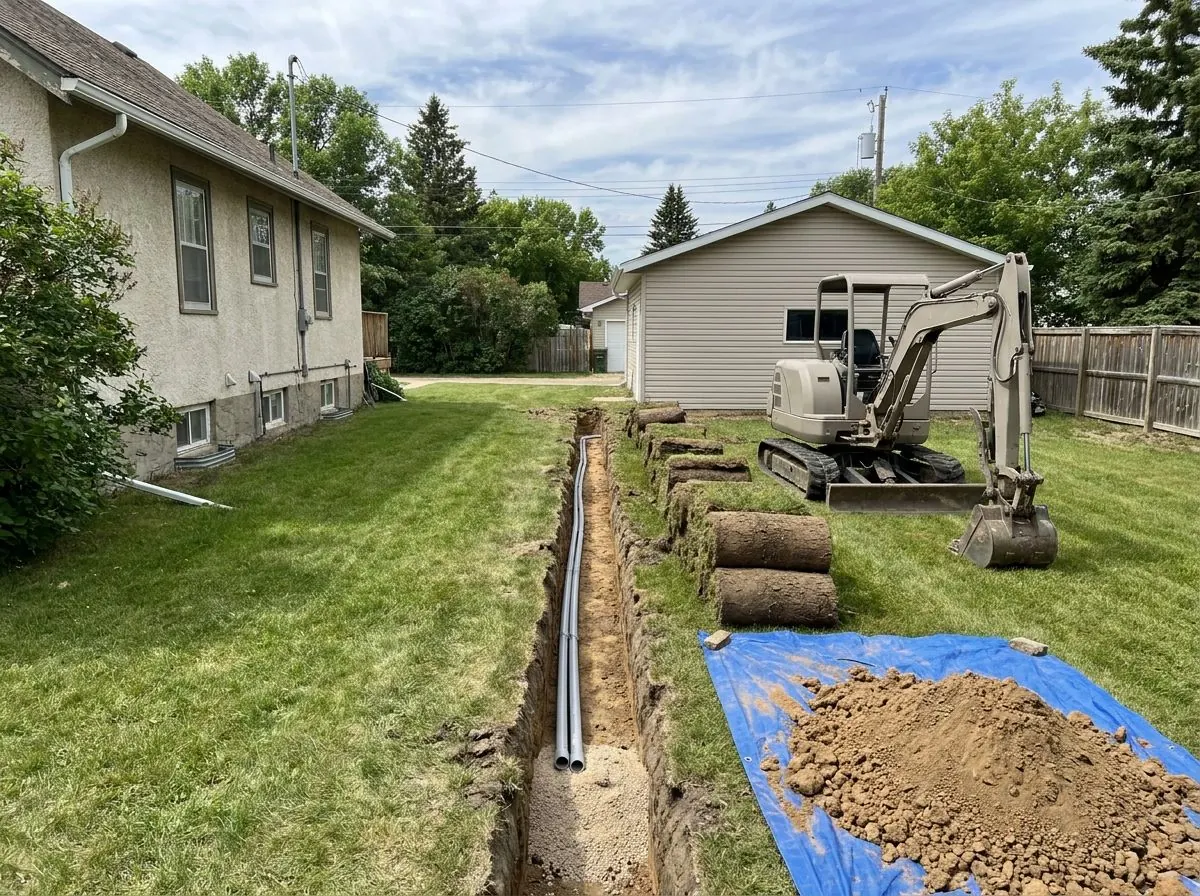
A shallow trench looks like the easy job, and that is the trap. The top metre or so of a residential lot is where many existing lines typically run: the gas service, the incoming power or telecom line, cable and fibre drops, irrigation, yard lighting, and whatever a previous owner ran to a garage or shed. A trench for a new gas line or power feed has to cross or parallel several of those, often in a yard with fences, trees and a finished lawn. One careless bucket pass into a gas service turns a landscaping-sized job into an evacuation and a utility emergency.
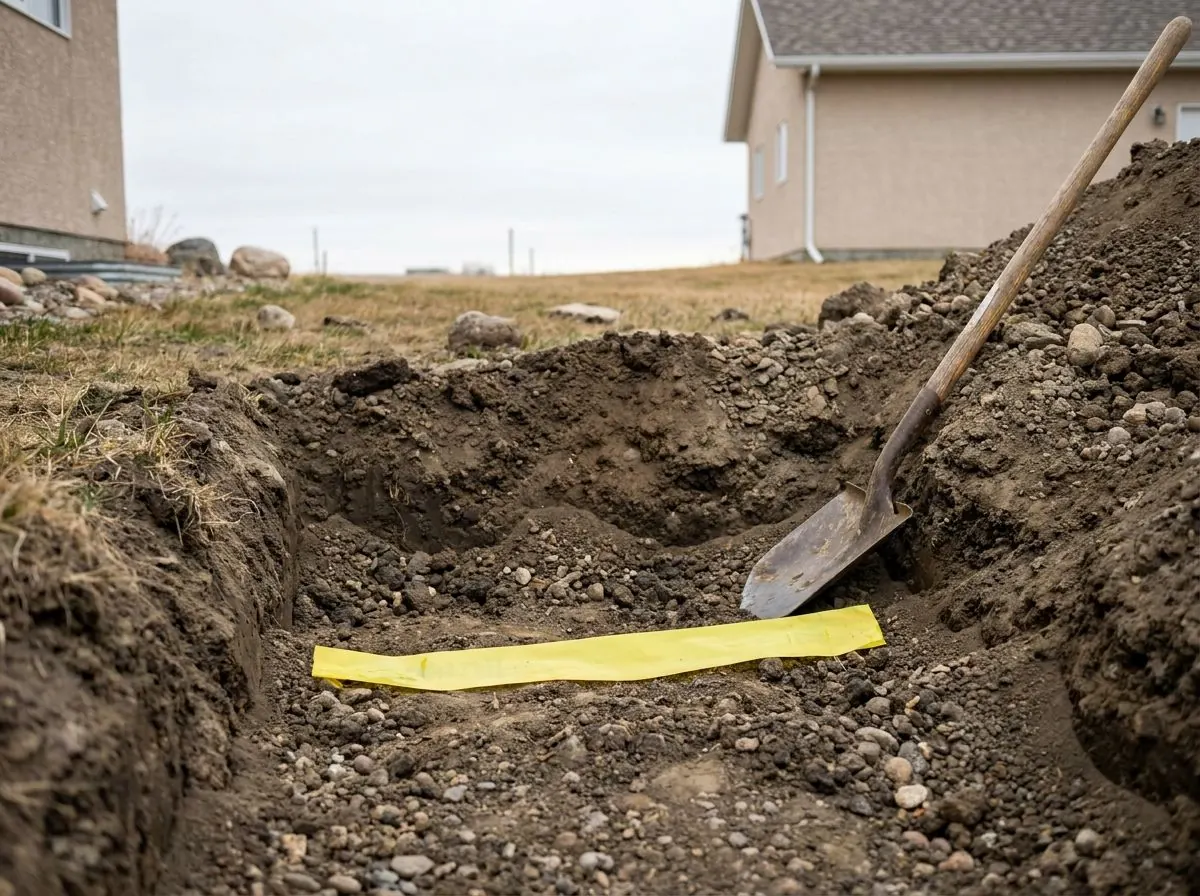
Depth and route mistakes cost almost as much as a strike. A power feed trenched shallower than the electrician’s permit calls for fails inspection and gets dug again. A gas line on the wrong route or at the wrong depth will not be accepted by the fitter or the utility. Cable and plastic pipe laid straight onto rocky clay can be scarred as the ground moves through freeze and thaw, and a line buried with no warning tape above it waits for the next person with a shovel to find it the hard way, sometimes years later during a fence or deck project.
Most of these jobs involve three or four parties who never meet: the owner, an electrician or gas fitter, the utility or fibre provider, and a landscaper who will put the yard back. When the trench is opened before anyone agrees on route, depth and inspection timing, it sits open across a week of rain waiting for an inspector, the walls cave, the bedding fills with mud, and the lawn gets torn up twice. The trench is the smallest line item on the project, yet it can cause a large share of the rework.
How It Works
We get the specification before we get the machine off the trailer. The route, depth, bedding, separation and warning-tape requirements come from the electrician, gas fitter or utility who owns the installation, and the start and end points are pre-marked in white paint for the locate. Because the utility locate stops at the utility’s own equipment, the owner is asked about every private line on the property, and where there is doubt a private locator is brought in before digging. Every marked crossing inside its hand-expose zone is exposed by hand or hydrovac first.
Then the tool is matched to the ground. A trencher cuts a narrow, consistent trench quickly with little spoil in open, rock-free soil where nothing crosses the route. A zero-tail-swing mini excavator with a narrow bucket is typically the better choice where the trench crosses existing lines, where old fill hides rock and concrete, where tree roots need clean cuts, or where the yard is too tight to turn a trencher. Close to a live line, a shovel or a hydrovac wand does the digging and the machine waits.
The trench is opened only when the installer is ready to use it, held open for the inspection the permit requires, and closed promptly. Sod and topsoil are lifted and set aside on tarps, clay goes to one side, and the trench bottom is cleaned of rock before bedding. After the line is laid and inspected, bedding goes around it, warning tape goes in at the specified height, and backfill returns in thin lifts compacted with a plate or rammer so the line of the trench does not show up as a sunken strip next spring.
How the Job Runs, Step by Step
Route walk with the installer
We walk the route with the electrician, gas fitter or provider, or work from their drawing, and confirm the depth, bedding, separation from other lines and where the line enters each building. Obstacles are flagged: trees to protect, fence posts, window wells, decks, and hard surfaces the trench must cross. The start, end and turning points are pre-marked in white. If the line crosses a City road right-of-way, the Excavation Permit and ULA number are arranged now.
Locates, private lines and crossings
With locate marks on the ground, the owner confirms any private lines the utility did not mark, such as an existing garage feed, a barbecue gas line or irrigation mains. Each place the new trench crosses a mark is exposed inside the hand-expose zone by hand or hydrovac, and its actual depth measured, because locate paint shows position, not depth. Exposed lines are supported so they cannot sag or break when the trench is cut beneath them.
Cut the trench
Sod is cut and rolled or lifted onto tarps with the topsoil, and the trench is cut to the specified depth and a width that suits the line and the installer’s hands. Spoil is kept at least 1 m back from the edge, even in a shallow cut, so it does not roll back in. Rock, concrete chunks and roots are cleaned out of the bottom, and depth is checked along the run rather than eyeballed at the ends.
Bedding and inspection hold
A bed of sand or screened, rock-free material goes into the trench bottom where the installer specifies it. The electrician, gas fitter or provider lays and connects the line, and the trench is held open, barricaded if needed, until any required inspection has been done. Only once the installer confirms the line can be covered does bedding go around and over it.
Tape, backfill and yard restoration
Warning tape is laid above the line at the height the installer or utility requires. Clay backfill returns in thin lifts, compacted with a plate or rammer, and topsoil and sod go back last so the trench line sits level with the lawn around it. Surplus material and any rock pulled from the trench leave with us, and hard surfaces that had to be cut are prepared for the trade who restores them.
Equipment on This Job
Zero-tail-swing mini excavator
A roughly 1–6 t machine whose counterweight stays within its tracks as it turns, so it can work along a fence line or between a house and garage without swinging into either. A narrow trenching bucket keeps the cut tight to the line and the spoil pile small.
Trencher
A chain trencher cuts a clean, uniform, narrow trench quickly in open ground, leaving a neat spoil row beside it. It is typically used on long, straight runs across acreage or open yards with no crossings, and set aside where rock, roots or existing lines make a mini excavator the safer tool.
Hand tools and hydrovac for crossings
Shovels, spades and, where the ground or depth calls for it, a hydrovac, used inside the hand-expose zone to uncover existing gas, power and telecom lines at every crossing before any machine works near them.
Plate compactor and compact track loader
A vibratory plate firms the sand bedding and the first thin lifts over the line without driving heavy impact onto it. A compact track loader, with lower ground pressure than a wheeled skid steer, moves bedding sand and topsoil across a finished yard without rutting the lawn.
What Decides the Specification
The line itself sets most of the specification. Gas piping, electrical conduit, direct-buried cable and fibre each come with their own depth, bedding and separation requirements from the utility, the applicable code and the installer’s permit, and a trench that serves more than one of them has to satisfy every one. We do not publish depth figures for these lines because they depend on the line type, what it crosses and where it runs, and the person who signs for the installation is the one who sets them. Our job is to dig to that number accurately along the whole run.
The ground sets the rest. Clean native clay trenches neatly but sticks and smears when wet; old fill around houses hides brick, concrete and rock that can damage a trencher chain and pierce a cable jacket; tree roots near the route may need hand cutting to protect the tree. The number of existing lines the trench crosses decides how much of the run has to be hand or hydrovac dug. Season matters too: frozen ground has to be thawed or dug non-destructively inside hand-expose zones, and frozen clods do not belong in backfill around a new line.
Code, Safety and Permit Notes
Alberta’s rules do not shrink because the trench is shallow. Under the OHS Code, hand-digging no deeper than 300 mm is not counted as ground disturbance as long as it does not permanently remove cover over a buried facility, but Utility Safety Partners’ own guidance is to treat any disturbance of the earth, regardless of depth, as ground disturbance, and that is how we treat it. Inside the hand-expose zone, 1 m each side of the marks or 5 m for a high-pressure pipeline, no mechanical equipment is used until the facility is exposed, and no mechanical equipment is used within 600 mm of a buried pipeline unless the owner’s representative is directly supervising.
Pipelines raise the stakes further. Alberta’s Pipeline Rules set a controlled area 30 m each side of a pipeline’s centreline, work within it needs notice to Utility Safety Partners at least 3 and not more than 10 days ahead, excluding weekends and holidays, and once a ground disturbance approaches within 5 m of a pipeline it must be exposed by hand. In the city, shallow utility work in a City road right-of-way needs an Excavation Permit and a Utility Line Assignment (ULA) number. Permits for the wiring or gas piping themselves are normally obtained by the electrician or gas fitter doing that work, not by the excavator.
General guidance only. The municipality, Alberta’s safety codes and the engineer of record, where there is one, decide what applies to your job.
Around Calgary
In inner-city communities such as Altadore and South Calgary, both classed by the City as inner city, a new backyard suite, detached garage or workshop can mean a power feed or gas line crossing a narrow rear yard between the house and the garage. A yard like that may hold fences, trees, window wells and private lines run by earlier owners that no utility locate will show, and space for spoil is limited. A zero-tail-swing mini excavator and plenty of hand digging usually do more here than any trencher, and the trench is closed the same way it was opened: carefully, so the neighbours’ fence and the owner’s lawn survive.
On acreages the runs get long. In Bearspaw, in Rocky View County, a power or fibre line to a shop, gate or second building can run a long way across two-acre parcels, and every private line the owner has installed over the years, from yard lights to a water line to a barn, is invisible to the utility locate. The Bearspaw plan describes slopes and coulees, and on a parcel with that kind of ground the route may need to follow a contour rather than a straight line. Here a trencher often earns its place on the open stretches, with a mini excavator and hand tools at the crossings.
Often Done Alongside
Hydrovac & Non-Destructive Daylighting
Non-destructive digging to expose buried lines before any machine gets close.
Deep Utility Trenching (Water, Sewer & Storm)
Shored, bedded trenches for water, sanitary and storm service lines.
Foundation Backfilling & Perimeter Grading
Compacted backfill against new foundations and a perimeter grade that sheds water.
Where We Do This Work
Calgary, quadrant by quadrant
Acreage country
Neighbouring cities and towns
Shallow Utility Trenching: Questions We Get
How do I use Click Before You Dig in Alberta, and how far ahead should I request locates?
Will the utility locate mark the power line to my garage?
How deep does a new gas line or electrical feed need to be buried?
Will you use a trencher or a mini excavator in my yard?
Can excavation be done in a Calgary winter?
Get a Written Estimate for Shallow Utility Trenching
Send the basics and we will come back with questions or a time to look at the site. Drawings, a geotechnical report or photos of the access all help.
Considering Shallow Utility Trenching?
Call Aspen Excavating or send the details. We will look at the site, tell you whether shallow utility trenching is the right scope, and price it in writing.