Emergency Utility Leak Dig-Outs in Calgary
A broken water service or failed sewer line cannot be fixed until someone finds it and digs it out safely. We handle priority dig-outs in Calgary: emergency locates, shoring, dewatering and exposing the break for your plumber or the utility, then compacted backfill once the repair is done.
The Problem It Solves
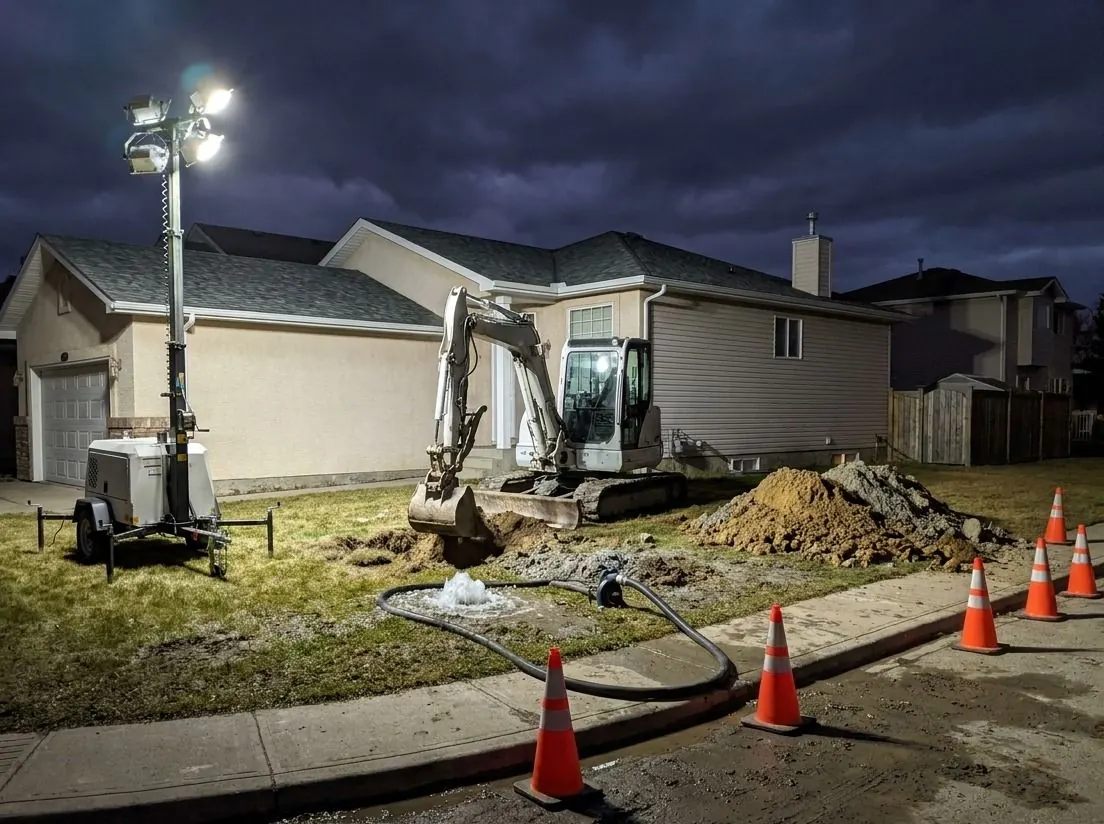
A broken water service rarely announces itself politely. Water surfaces in the lawn or bubbles up beside the driveway, the basement floor goes damp along one wall, pressure at the taps falls away, or a soft spot opens into a sinkhole. A failed sewer service shows up as repeated backups and slow drains, and a camera run by a plumber finds a collapsed section, an offset joint or a crushed pipe that cannot be fixed from inside. In each case the pipe is buried, usually deep, and the repair cannot start until someone reaches it.
Every hour water keeps running can do more damage than the break itself. It washes fine soil out from under slabs, sidewalks and driveways, saturates the backfill against the foundation and can push water into the basement. Sewage leaking into the ground is a health problem as well as a structural one. In winter the pressure is worse: frozen services and broken pipes arrive together, and in the extreme winter of 2019 the City reported frost reaching 2.4 m (8 ft), close to the depth at which water services are buried. Waiting for spring is seldom an option.
The first hour is also when the worst decisions get made. Nobody is sure whether the leak is on the private side or the City side, whether it is water or gas, or who is supposed to dig. Someone grabs a shovel, or a machine shows up and starts digging without locates near a gas line. The hole is deep, the soil around a leak is saturated and at its least stable, and a frozen crust on top looks solid when it is not. Then the repair is rushed, frozen lumps go back in the trench, and the driveway sinks the following spring.
How It Works
We start on the phone, before anything moves. We ask what you are seeing and where: water in the yard, in the basement, or in the street, boulevard or sidewalk. We ask whether anyone smells gas, and if so, the conversation ends with getting out and calling 911 and the gas utility. We ask whether the main shut-off is closed, who is doing the repair (a plumber, the utility, or a utility indemnified contractor for work in the City right-of-way) and what is known about the line. That tells us whose side the break is likely on, what locates are needed and what machine and protection the dig will take. This triage is our priority dispatch process: calls are ranked by safety risk and active damage, the crew and machine are matched to the depth and access before they leave, and we tell you honestly when they can arrive rather than promising a time we cannot control.
On site, the locate request goes in by phone as an emergency or priority request, and the owner or a private locator marks private lines, because utilities do not mark the private side. Machines dig only outside the hand-expose zone of 1 m either side of each locate mark; inside it, lines are exposed by hand or by a non-destructive method the line owner accepts, such as hydrovac. We pump water out of the excavation as we go, keeping sewage-contaminated water away from storm inlets and streets, and we slope the walls or set a protective structure as soon as the depth calls for it. Spoil goes at least 1 m back from the edge so it does not load a wall that is already wet.
The break is exposed with enough working room around the pipe for the plumber or utility to cut out and couple a repair safely, and exposed pipe is supported so it does not sag or crack further. Once the repair is done and whoever is responsible has cleared it, we backfill in thin lifts with unfrozen material, keep heavy compactors off the pipe, and compact to the specification that applies. If the hole has to stay open overnight, it is marked, barricaded and covered or fenced. What the owner gets is a leak that was found and reached without hitting anything else, and a trench that does not sink next year.
How the Job Runs, Step by Step
Make it safe and triage the call
Any hint of gas comes first: people out, no flames or switches, then 911 and the gas utility, and no digging until the gas utility has made the site safe. For water, we ask you to close the main shut-off if you can reach it safely, and we work out whether the break is likely on the private side or in the City right-of-way. If water is surfacing in the street, boulevard or sidewalk, The City of Calgary needs to know, since that part of the line lies in its right-of-way. We confirm who is making the repair so the dig is set up for them.
Emergency locates and private lines
Emergency and priority locate requests go to Utility Safety Partners by phone, not through the online system, and we place that request as soon as the dig is confirmed. Utilities mark their own lines at no charge, although after-hours locates can carry overtime charges from some operators. Water and sewer piping past the property-line shut-off, power to a garage and other private lines are not marked, so the owner points them out or a private locator marks them. Nothing mechanical happens until every line in the area is marked or cleared.
Dig, protect and dewater
The excavator removes soil outside the hand-expose zone, and lines inside the zone are exposed by hand or hydrovac. As the hole passes 1.5 m, the walls are sloped back or a protective structure goes in before anyone enters, and a safe way out is kept within reach. Pumps keep water down so the bottom stays workable and the walls do not slough. Spoil is kept at least 1 m back from the edge, and in frozen ground the frost is broken or thawed, never trusted as support.
Expose the break and hold the hole for the repair
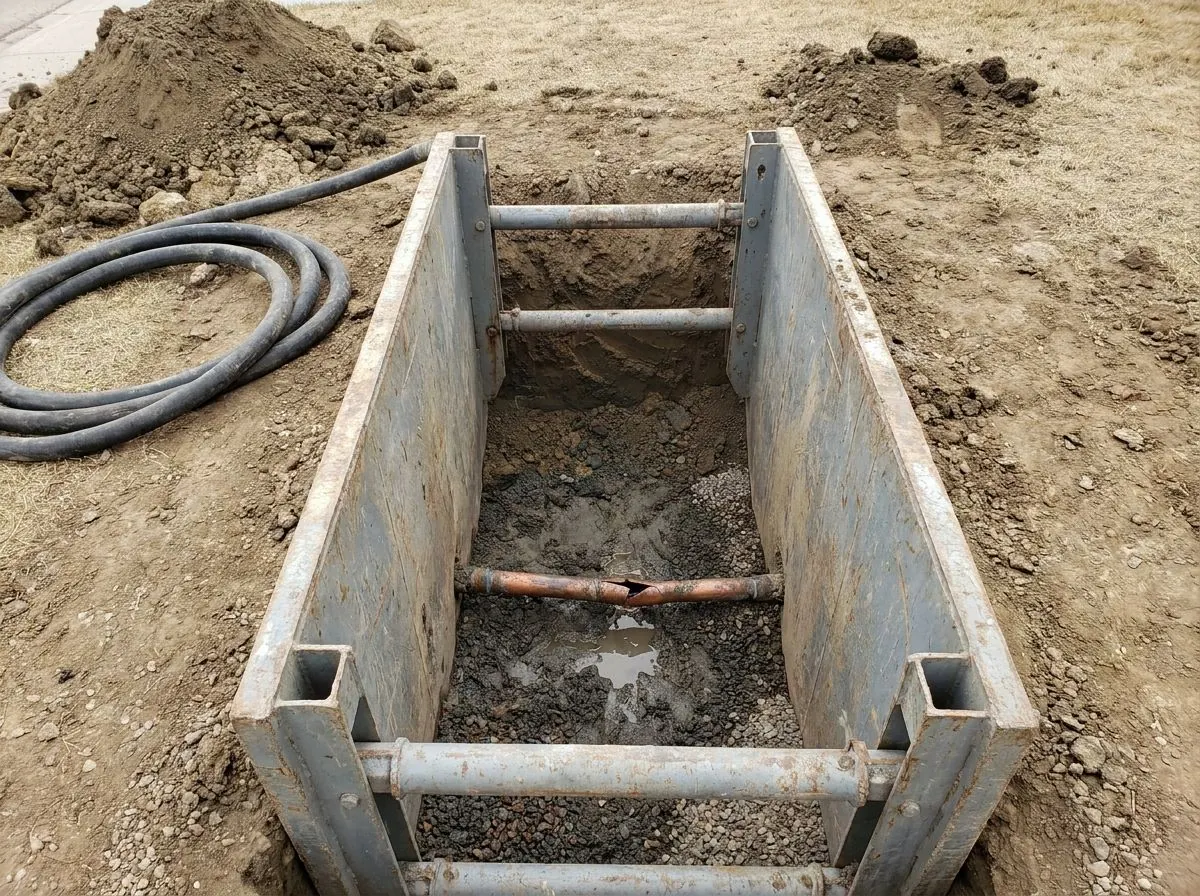
We dig to the line and follow it toward the leak, finishing the last of the digging around the pipe carefully so the break is exposed without extra damage. The excavation is widened and levelled at the bottom so the plumber or utility has room to cut out the damaged section and work safely. Exposed pipe is supported along its length. We keep pumping and hold the site while the repair is made, and we do not backfill until the person responsible for the repair says it is ready.
Backfill, compact and protect the site
Bedding around the repaired pipe is placed the way the repairer or the utility requires, then the trench is backfilled in thin lifts of unfrozen material. On a water service, heavy compaction equipment stays off the zone 600 mm above the pipe, and the lifts above are compacted with rammers or plates. Any hole that cannot be closed the same day is marked, barricaded and covered or fenced. Surfaces are rough-restored, and if winter backfill settles, it is reworked once conditions allow rather than left as a hazard.
Equipment on This Job
Mini and midi excavators, roughly 1–10 t
Fit through side yards, past fences and onto driveways, where a private service commonly runs between the house and the property line, and have the reach to dig to service depth. Zero-tail-swing models work beside a house wall or in a lane without swinging the counterweight into anything.
Hydrovac and hand tools
Expose gas, power and communication lines inside the hand-expose zone without striking them, and clear soil around the broken pipe itself. Hydrovac is typically run with heated water in frozen ground. The slurry it collects is waste and goes to an approved facility, never onto the street.
Temporary protective structure
A trench box or shoring system set as the dig passes 1.5 m, so the plumber or utility crew can work at the pipe with the walls held back. Where saturated soil or a nearby foundation makes sloping impractical, the structure is what keeps the repair crew safe; past 3 m it must be engineer-designed.
Dewatering pumps
Keep the leak, groundwater and surface runoff pumped down so the bottom of the hole stays workable and the walls do not wash out. Where the discharge goes is chosen deliberately: contaminated water from a sewer break is not pumped to a storm inlet, a street or a neighbour’s yard.
What Decides the Specification
Depth is the first thing that shapes an emergency dig. In Calgary, water mains and services are laid with 2.7 m (9 ft) of cover in clay and 3.3 m (11 ft) in gravel on looped systems, and 3.0 m (10 ft) in clay on dead ends; sanitary sewer mains need at least 2.5 m of cover and storm mains 1.2 m. Soil type decides how far walls must be sloped or whether a protective structure is faster, and a foundation close to the dig can require engineered support before digging starts.
Water and season decide the rest. A break still under pressure because the shut-off cannot be closed floods the hole as fast as it is dug, so shutting the water off is often the first real step. Groundwater near the rivers can add to the pumping. In winter, Calgary’s frost is typically around 2 m and reached 2.4 m (8 ft) in 2019, so the upper part of the dig is frozen and must be broken or thawed; frozen ground does not remove the duty to hand-expose lines inside the hand-expose zone. Backfill has to be unfrozen, which in January can mean bringing in material rather than reusing the frozen spoil.
Code, Safety and Permit Notes
Locate rules do not pause for an emergency. Utility Safety Partners requires emergency and priority locate requests by phone, and the Alberta OHS Code still requires buried facilities to be marked before ground is disturbed and to be exposed by hand, or by a non-destructive method the owner accepts, within 1 m of the marks, or 5 m for a high-pressure pipeline. If a marked line cannot be found, provincial guidance is to attempt exposure to 600 mm below the planned dig depth and then call the owner. Workers do not enter an excavation deeper than 1.5 m without sloping or protection, any trench over 1.5 m needs a safe exit within 8 m of the worker, and natural freezing may never be used in place of a protective structure.
In Calgary, the owner is responsible for the water and sewer service from the property line to the building’s plumbing, and service connections in the City right-of-way must be installed by a utility indemnified contractor, so a break on the public side is not a job for whichever contractor the owner happens to call; confirm with the City who arranges that repair. Digging into a City road right-of-way needs an Excavation Permit under the Streets Bylaw; ask the City how its emergency process applies to your break. Separately, the City notes lead service connections were used mainly between 1939 and 1947 and that most services, including in pre-1950 homes, are copper; if a dig-out exposes an older service, contact the City.
General guidance only. The municipality, Alberta’s safety codes and the engineer of record, where there is one, decide what applies to your job.
Around Calgary
Older Calgary communities are where services have been in the ground the longest. The City classes places like Capitol Hill and Glendale as 1950s-era communities, and Ramsay as inner city, and on lots like these a failing service often runs under a mature yard, a detached garage pad or a narrow side yard with no room for a large machine. Sewer services of that age can have root intrusion or shifted joints, and water services may be copper, galvanized steel or, in some homes from the war years, lead; the City asks owners who suspect lead to contact it. That points to small machines, protection for the yard, and planning for concrete over the line to be broken out and set aside for the restoration trade.
Near the rivers, water is a problem before the leak is even reached. In Elbow Park, Rideau and Roxboro, a University of Calgary study reported that groundwater flooding caused much of the 2013 basement damage, and deeper basements reported more groundwater flooding, so a deep service dig in those communities is planned with serious pumping capacity rather than hoping the hole stays dry. In winter the issue flips to frost: a service break in January means cutting through frozen ground first, exposing lines by hand or hydrovac inside the hand-expose zone, and bringing unfrozen backfill so the trench does not settle when spring arrives.
Often Done Alongside
Hydrovac & Non-Destructive Daylighting
Non-destructive digging to expose buried lines before any machine gets close.
Deep Utility Trenching (Water, Sewer & Storm)
Shored, bedded trenches for water, sanitary and storm service lines.
Foundation Backfilling & Perimeter Grading
Compacted backfill against new foundations and a perimeter grade that sheds water.
Where We Do This Work
Calgary, quadrant by quadrant
Acreage country
Neighbouring cities and towns
Emergency Dig-Outs: Questions We Get
Is a leaking water service my repair or the City’s?
Can utility locates be done on an emergency basis?
Can a broken line be dug out in the middle of winter?
Do you repair the sewer or water line yourselves?
Who handles utility locates and permits?
Get a Written Estimate for Emergency Dig-Outs
Send the basics and we will come back with questions or a time to look at the site. Drawings, a geotechnical report or photos of the access all help.
Considering Emergency Dig-Outs?
Call Aspen Excavating or send the details. We will look at the site, tell you whether emergency dig-outs is the right scope, and price it in writing.