Excavation for Acreages and Farms in Rocky View County and Foothills County
An acreage asks more of an excavator than a city lot does. The driveway has to carry a loaded concrete truck in spring, the culvert under the approach has to pass meltwater without icing shut, and the septic field has to fit between the well, the house and the property line. A new shop needs a pad that won’t heave, and a dugout has to hold water without flooding the neighbour. Most of that work also runs through the county, not the City, with its own permits and inspections.
We work on acreages and farms across Rocky View County and Foothills County, from the two-acre country residential parcels of Springbank and Bearspaw to the traditional acreages around De Winton. Some of these properties rely on wells and septic, others are on piped servicing, and the ground ranges from open prairie to rolling foothills and coulees. We plan each job around the county’s approvals, the private lines no locator will mark, and the heavy equipment and trucks the property has to take.
Driveways that carry heavy trucks
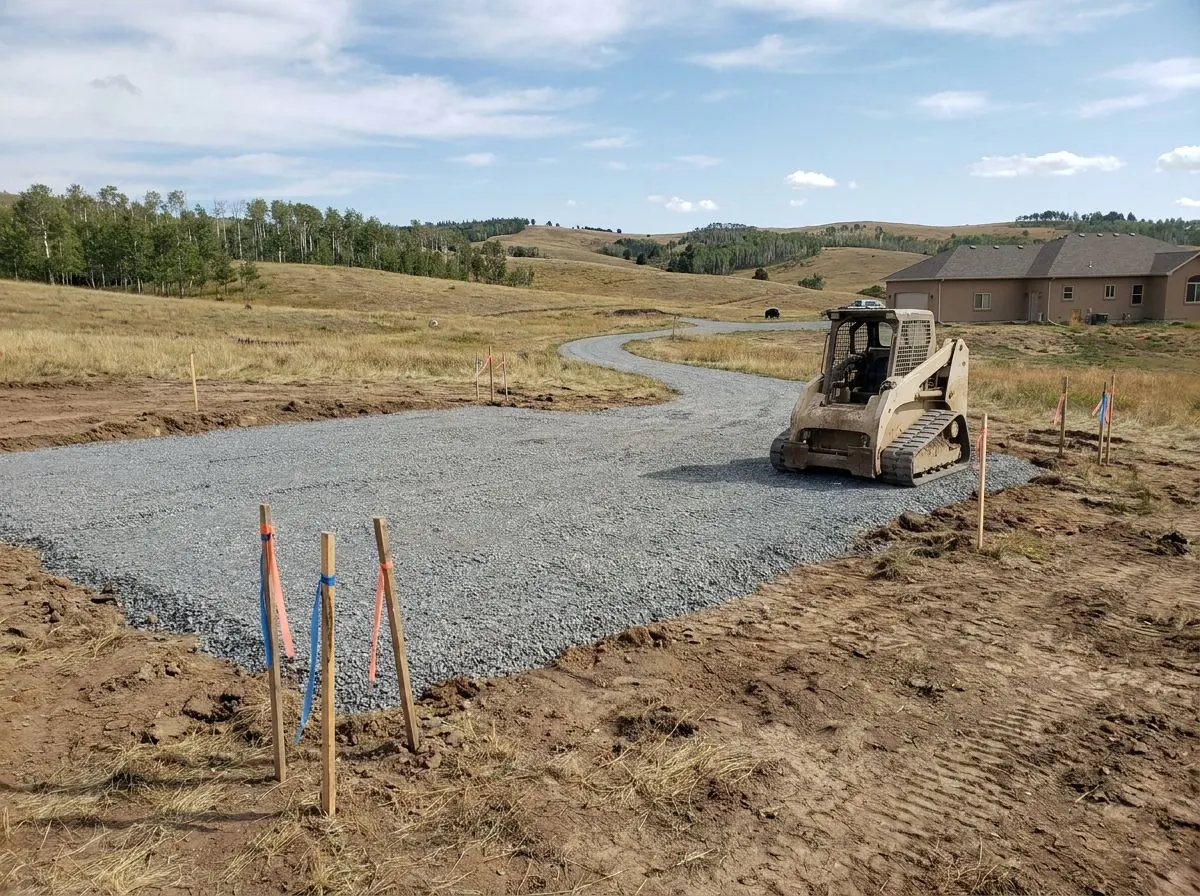
An acreage driveway gets built for the heaviest thing it will carry during construction, not the family car. That means stripping topsoil, building up a firm subgrade, typically a geotextile separation fabric over soft ground, and compacted crushed gravel with a crown and ditches to shed water. In Rocky View County, the approach grade off the county road is limited to 4%, and new approaches are inspected before and after.
Culverts sized and approved
Rocky View County requires permission for any work in its rights-of-way, including installing, altering or removing a culvert, and a Road Approach Application for new approaches. Its servicing standards set a minimum of 450 mm for approach culverts, and a culvert is typically required unless the approach sits at a high point. We install and bed the pipe to the approved size and set the ditch grade so it drains through.
Septic excavation with a certified installer
In Alberta, only contractors holding a current certificate of competency can pull private sewage permits, and systems follow the 2021 Standard of Practice. We dig the soil test pits, the tank hole and the field trenches or mound base to the design, keeping setbacks such as 15 m from a well to any treatment field lateral. Both counties inspect private sewage before backfill is complete.
Dugouts and ponds
Under Alberta’s Water (Ministerial) Regulation, a dugout for agricultural or household use generally needs no Water Act approval, unless it sits in a wetland or watercourse, would change the flow of water onto an adjacent parcel, or holds more than 7,500 m³, among other exceptions. Alberta’s Quality Farm Dugouts guide calls for at least five or six test holes or pits dug 1.2–1.5 m (4–5 ft) deeper than the planned bottom before committing to a site.
Shop pads and building sites
A shop or barn pad is stripped of topsoil, cut or filled to grade, and built up in compacted lifts so the slab does not settle unevenly. Foothills County states that no construction, including foundation or excavation work, may start before a permit is issued. Rocky View County offers a foundation permit that allows excavation while the building permit application is still under review.
Clearing without new erosion
Brush, trees, stumps and rocks come out ahead of a building site, driveway or fence line, and stumps are grubbed so roots don’t rot under a pad. Topsoil is stockpiled for reuse, and bare slopes are shaped so runoff doesn’t cut gullies before new growth takes hold. On coulee and foothills ground, where a bare slope drains matters as much as what was cleared from it.
How an acreage job comes together
- A walk of the property to find the well, the septic tank and field, power and water lines to outbuildings, and any pipeline right-of-way markers
- A locate request for utility-owned lines, plus a private locator where you have buried power, water or other lines of your own
- A check for pipelines within 30 m of the work, as Alberta’s OHS Code and pipeline rules require, with hand exposure once work comes within 5 m of one
- County approvals sorted before the dig: road approach and culvert permissions, building or foundation permits, and private sewage permits through the certified installer
- Truck and machine access planned for the whole job, including whether hauling on Rocky View County roads needs a Road Use Agreement or permit
- Work paused for the county’s inspections where required, such as private sewage before backfill
- Topsoil respread, ditches shaped and disturbed ground left graded to drain away from buildings, the well and the septic field
Services That Come Up Most
Driveway & Access Road Rough-In
Acreage driveways and access roads built on geotextile and crushed gravel.
Culvert Installation & Ditch Re-Grading
Acreage driveway culverts, approach approvals, riprap ends and ditch re-grading.
Septic System & Field Excavation
Test pits, tank holes and treatment field trenches for acreage septic systems.
Pond, Dugout & Retention Basin Digging
Acreage dugouts, ponds and engineered stormwater basins, dug from test holes up.
Land Clearing & Vegetation Removal
Brush, trees, stumps, roots and boulders removed; mulched or hauled away.
Mass Earthworks & Site Grading
Cut and fill, topsoil stripping and laser or GNSS grading to design elevations.
Acreage & Farm Owners: Questions
Will the locate service mark my well, septic and shop power?
What size culvert does my driveway approach need?
Do I need approval to dig a dugout on my land?
Planning a driveway, shop, septic field or dugout?
Tell us where the property is, what you want built and what is already buried there, and we will lay out the dig, the county approvals and the truck access.